

If you’ve ever stared at your retirement statements and thought, “Is there a better way to grow my money without the roller‑coaster of the market?” – you’re not alone.
We’ve heard families whisper the same worry when the 401k‑to‑indexed universal life conversation pops up at the kitchen table. One moment you’re filing your 401k contributions, the next you’re hearing about “indexed universal life” and wondering if it’s a fancy insurance gimmick or a real alternative.
Here’s the thing: 401k vs indexed universal life isn’t a battle of “good vs bad.” It’s more like choosing the right tool for a specific job. A 401k is a tax‑deferred savings vehicle that most employers set up for you. An IUL, on the other hand, is a life‑insurance policy that also lets you build cash value tied to a market index, while protecting you from downside losses.
In our experience, families looking for affordable coverage often start with the 401k because the payroll deduction feels effortless. But many of those same families later realize they want a safety net that can also serve as a supplemental retirement pool – that’s where the IUL shines.
Think about it this way: Imagine you’re buying a house. The 401k is like a mortgage with a fixed interest rate – predictable, but you can’t tap the equity without refinancing. An IUL is more like a home equity line of credit that grows as the market rises, yet the bank won’t let you owe more than the house is worth.
Does this mean one is always better? Not at all. The right answer depends on your cash‑flow needs, how comfortable you are with market risk, and whether you value the death benefit that comes with an IUL.
So, what should you do next? Start by listing your top priorities: tax efficiency, guaranteed income, flexibility, or legacy protection. Then match those priorities to the strengths of each option.
We’ll walk through the key differences – contribution limits, tax treatment, growth potential, and the living benefits that an IUL can add – so you can feel confident about the path that fits your family’s future.
Ready to dive deeper? Let’s unpack the details and see which strategy lines up with your retirement dreams.
TL;DR
Choosing between a 401k and an indexed universal life (IUL) policy hinges on whether you prioritize tax‑deferred growth with employer matching or a flexible, market‑linked cash value plus death benefit.
We break down contribution limits, tax treatment, risk exposure, and living benefits so you can match your family’s cash‑flow needs and legacy goals to the right solution.
Understanding the 401(k) Retirement Plan
Ever felt a little uneasy scrolling through your 401(k) statement, wondering if you’re really on the right track? You’re not alone. Most families I talk to admit they glance at the numbers and then drift back to the day‑to‑day hustle, hoping the plan will take care of itself.
Let’s pause a second. A 401(k) is essentially a tax‑deferred savings account that your employer sets up for you. Your paycheck gets a little slice tucked away before taxes, and many employers throw in a matching contribution – free money, if you will. That match can be the difference between a modest nest egg and a comfortable retirement.
How Contributions Work
In 2025, the contribution limit sits at $23,000 for those under 50, with an additional $7,500 catch‑up for anyone 50 or older. That means if you’re 55, you could potentially stash $30,500 a year, all growing tax‑free until you start taking distributions.
But here’s a kicker: the IRS caps the total amount you can contribute across all employer‑sponsored plans. If you have both a 401(k) and a 403(b), you’ll need to watch that combined limit.
Employer Match – The Real Sweet Spot
Imagine you earn $60,000 a year and your employer matches 50% of the first 6% you contribute. That’s $1,800 extra heading straight into your account, never seeing the tax man until withdrawal. It’s like getting a raise you didn’t have to ask for.
In our experience, families who maximize the match often feel a surge of confidence. It’s a tangible reminder that their retirement plan is working for them.
Tax Treatment and Withdrawals
Money grows tax‑deferred, meaning you won’t owe income tax on earnings until you pull the money out. When you retire, withdrawals are taxed as ordinary income. That can be a blessing if you’re in a lower tax bracket then, but it’s also a risk if tax rates climb.
And what about early withdrawals? Generally, you’ll face a 10% penalty plus income tax if you touch the account before age 59½, unless you qualify for an exception (like a first‑time home purchase or certain medical expenses).
If you’re curious about how a 401(k) can transition into a guaranteed income stream, check out our guide on 401(k) & 403(b) rollovers to annuities.
Investment Options Inside a 401(k)
Most plans give you a menu of mutual funds – typically a mix of stock, bond, and target‑date funds. You pick the allocation, and the plan’s record‑keeper handles the rest. The downside? You’re limited to what the employer offers, and fees can vary widely.
Think of it like a cafeteria: you can only choose from the dishes on the board, and sometimes the healthier options cost a little extra.
So, does this really work for you? It depends on your comfort with market swings, your timeline, and whether you value the simplicity of payroll deductions.
For seniors, preserving hearing health is another piece of the retirement puzzle – consider resources from Brighter Ears to keep you fully engaged in the moments that matter.
Beyond the numbers, think about the paperwork that comes with your 401(k). Annual statements, beneficiary designations, and rollover documents all need a safe spot.

Protecting your important documents, like 401(k) statements, is essential; Midnight Scriber offers fire‑proof document bags that keep your financial records safe from accidents.
To sum it up, the 401(k) is a solid foundation for most families: tax‑deferred growth, employer match, and a relatively low barrier to entry. It isn’t the whole house, but it’s a sturdy first floor. In the next section we’ll explore how an Indexed Universal Life policy can sit on top of that foundation, adding flexibility and a death benefit you can actually use while you’re alive.
What Is Indexed Universal Life (IUL) Insurance?
Imagine you could lock in a lifelong death benefit while also letting a portion of your premiums grow like an index fund—without ever watching the market dip below zero. That’s the core idea behind an Indexed Universal Life (IUL) policy. It’s a permanent life‑insurance contract that does two things at once: protects your loved ones if you pass away, and builds cash value that you can tap later.
How the cash‑value engine works
When you pay a premium, the insurer splits it. A baseline amount covers the pure insurance cost—think of it as the “mortality charge.” The rest slides into a cash‑value account that’s tied to a market index, usually the S&P 500 or Nasdaq. If the index climbs, the policy credits a portion of that upside to your cash value. If the index falls, you’re shielded; the policy guarantees a 0% floor, so you never lose money because of market drops.
Because the crediting is based on an index, not on actual stock ownership, you don’t pay capital‑gains tax on the growth. The cash value grows tax‑deferred, just like a 401(k), but you can borrow against it tax‑free (as long as the policy stays in force).
Real‑world example: The Martinez family
John and Ana Martinez, both teachers in a suburban district, wanted a safety net for their two kids and a way to supplement their retirement. They bought a $500,000 IUL with a $2,000 monthly premium. After the first year, the S&P 500 rose 10%. Their policy’s participation rate was 80%, so 8% of that gain was credited—plus a 1% guaranteed floor. Their cash value jumped from $0 to about $23,000. Fast forward five years, despite a market dip of 12% in year three, the floor kept their cash value from shrinking. By year five, the cash value sat around $150,000, which they could borrow against for a down‑payment on a rental property.
Notice the two benefits in action: the death benefit stayed level at $500,000, and the cash value grew without any market‑loss pain.
Key features you should watch
- Cap rate: Most policies cap the annual credited rate (often 10‑12%). Even if the index soars 20%, you only get the cap.
- Participation rate: This determines how much of the index’s gain you actually receive (e.g., 80%).
- Cost of insurance: As you age, the mortality charge rises, which can eat into cash value if premiums aren’t adjusted.
- Loan interest: Borrowing is tax‑free, but you’ll owe interest to the insurer. Unpaid loans reduce the death benefit.
Actionable steps to evaluate an IUL for yourself
1. Map your goals. Do you need pure protection, retirement cash, or both? Write down the amount of death benefit you’d feel comfortable leaving for your family.
2. Run the numbers. Ask a licensed agent for a side‑by‑side illustration that shows cash‑value growth under three scenarios: modest index gain, flat market, and high growth (capped). Compare the projected loan value after 10‑15 years.
3. Check the policy charges. Look at the admin fee, cost of insurance, and any surrender charges. Those can shave a few percentage points off your effective return.
4. Test the loan feature. Request a sample loan scenario—say, borrowing $30,000 at age 55. Verify the interest rate and how it affects the death benefit.
5. Plan for premium flexibility. Many IULs let you increase or decrease payments within limits. If cash flow tightens, you can reduce premiums for a while, but be aware of the impact on cash value.
Expert tip: Blend IUL with your 401(k)
In our experience, families who pair a solid 401(k) foundation with a modest IUL gain flexibility. The 401(k) still offers employer match and high contribution limits, while the IUL adds a tax‑free withdrawal option and a legacy benefit. When you’re ready to retire, you can use 401(k) withdrawals for everyday expenses and dip into an IUL loan for larger, non‑taxable purchases—like a vacation home or unexpected medical bills.
For a side‑by‑side comparison of growth potential, tax treatment, and flexibility between these two tools, see the SmartAsset analysis on IUL vs 401(k). It breaks down the math in plain language and helps you see where each vehicle shines.
Below is a quick video that walks through the basics of IUL mechanics. It’s a good primer before you sit down with an agent.
After watching, take a few minutes to jot down three questions you still have—maybe about caps, loan interest, or how to keep the policy from lapsing. Those questions will make your next conversation with a licensed professional far more productive.
Bottom line
An Indexed Universal Life policy isn’t a magic bullet, but it can be a powerful complement to a traditional 401(k). It gives you a death benefit, a tax‑advantaged cash‑value engine, and the ability to borrow without triggering a taxable event. The trade‑off is cost: caps, participation rates, and insurance charges can dampen returns if you’re not careful. By following the steps above and treating the IUL as a strategic piece of a broader retirement puzzle, you’ll be better positioned to protect your family and grow wealth on your own terms.
Feature-by-Feature Comparison: 401(k) vs Indexed Universal Life
Alright, let’s put the two options side by side so you can actually see where each shines and where it might leave you hanging.
Ever wonder why some families treat their 401(k) like a savings account and others talk about borrowing against an IUL like it’s a secret weapon? The answer lies in the nuts‑and‑bolts – contribution limits, tax treatment, flexibility, and the built‑in death benefit.
Contribution Limits & Cash Flow
A 401(k) caps you at $23,500 for 2025 (plus $7,500 catch‑up if you’re 50+). That sounds generous until you realize it’s a hard ceiling – you can’t just toss more in when you get a bonus.
An IUL, on the other hand, lets you pay as much premium as you can afford, subject to the IRS’s “7‑pay test” to keep it classified as life insurance. In practice, families often end up contributing $2,000‑$5,000 a month, but the ceiling is far higher than a 401(k).
Tax Treatment
Both vehicles grow tax‑deferred, but the exit strategies differ. 401(k) withdrawals are taxed as ordinary income, which can bite you hard in retirement, especially if you’re pulling out large sums.
With an IUL you can take policy loans or withdrawals up to your cost basis without triggering income tax. As long as the policy stays in force, those loans are essentially tax‑free money – a feature many families use to cover college tuition or a down‑payment.
Growth Potential & Market Exposure
401(k) investments sit directly in the market. If you pick a 100% stock index fund and the market tanks, your balance follows suit. The upside can be huge, but the downside is real.
An IUL credits interest based on an external index (usually the S&P 500) but never lets you lose money because of a market dip – the floor is 0%. The trade‑off is a cap (often 10‑12%) and a participation rate (typically 80%). So you get some market upside without the fear of loss, but you won’t capture a bull run fully.
Access to Cash & Flexibility
Need money before retirement? 401(k) penalties and taxes make early withdrawals painful unless you qualify for a hardship exception.
IUL policies let you borrow against cash value at any time. No 10% early‑withdrawal penalty, no IRS‑mandated age, just interest on the loan. That flexibility can be a lifesaver for unexpected medical bills or a home‑repair emergency.
Cost & Fees
401(k) fees are usually low‑cost expense ratios on mutual funds, plus a possible admin fee from your employer’s plan provider.
IULs carry mortality charges, administrative fees, and the cost of the insurance rider. Those costs can eat into cash‑value growth, especially in the early years, so it’s crucial to run the numbers with a licensed agent.
Death Benefit & Legacy
A 401(k) passes to your heirs, but they inherit it as taxable income – the tax bill can erode the legacy you intended.
An IUL includes a guaranteed death benefit that’s generally income‑tax free for beneficiaries. It’s a built‑in legacy tool that many families value as part of their overall estate plan.
Who Might Prefer Which?
If you’re a young family focused on maximizing employer match and keeping things simple, the 401(k) is often the first step.
If you’re looking for a tax‑free retirement supplement, want a safety net that can be tapped without penalties, and care about leaving a tax‑free inheritance, an IUL becomes very attractive.
| Feature | 401(k) | Indexed Universal Life (IUL) |
|---|---|---|
| Contribution limit (2025) | $23,500 (+$7,500 catch‑up) | Flexible premium; much higher ceiling |
| Tax on withdrawals | Ordinary income | Policy loans tax‑free (if policy stays in force) |
| Market risk | Direct exposure | 0% floor, cap & participation limits |
| Early access | Penalties & taxes | Loans anytime, no penalty |
| Death benefit | Taxable to heirs | Income‑tax free death benefit |
So, what’s the next move? Grab a notebook, list your top three priorities – tax efficiency, liquidity, or legacy protection – and compare them against the rows above. If liquidity and a tax‑free legacy rank high, start a conversation with a licensed IUL specialist. If you’re still chasing that employer match, make sure you’re hitting at least the full match before you look elsewhere.
Remember, the best retirement plan is often a blend: a solid 401(k) foundation plus a strategically sized IUL to fill the gaps. That combo lets you enjoy the free money from your employer while keeping a safety valve for life’s unexpected turns.
Tax Implications and Retirement Planning
When tax season rolls around, many families stare at the numbers and wonder if there’s a smarter way to keep more of what they’ve earned. That’s where the real difference between a 401(k) and an indexed universal life (IUL) starts to matter.
How a 401(k) hits your taxes
Contributions to a traditional 401(k) lower your taxable income today, which feels like an instant win. But the trade‑off is that every dollar you withdraw in retirement shows up as ordinary income. If you’re in a higher bracket then, those withdrawals can push you into the next tax tier and even increase Medicare premiums.
What we’ve seen work best is planning your withdrawals to stay under the threshold that triggers the higher rate. That often means pulling a modest amount each year and letting the rest keep growing tax‑deferred.
IUL loans: a tax‑free alternative
With an IUL, the cash‑value grows tax‑deferred just like a 401(k), but you can tap it with policy loans that aren’t considered taxable income—provided the policy stays in force. In practice, you’re borrowing against your own cash, not taking a distribution from a retirement account.
Imagine you’re 58, you’ve built $120,000 of cash value, and you need $30,000 for a home‑improvement project. Instead of cashing out a 401(k) and taking a 20% tax hit, you could take an IUL loan, repay it with interest, and keep the rest of your retirement savings growing untouched.
RMDs versus no‑RMDs
Once you turn 73, the IRS forces you to take required minimum distributions (RMDs) from every traditional 401(k) and traditional IRA. Those RMDs are fully taxable and can create a surprise tax bill.
An IUL, on the other hand, isn’t subject to RMD rules. You can let the cash value sit, grow, and be accessed on your own schedule. That flexibility is a huge relief for families who want to control their taxable income year‑by‑year.
Strategic blend: using both vehicles
So, does one replace the other? Not usually. In our experience, the smartest retirees treat the 401(k) as the “core savings engine” and the IUL as the “tax‑free safety valve.” Here’s a quick checklist you can run through tonight:
- Calculate your expected retirement income needs and estimate the tax bracket you’ll likely be in.
- Project your 401(k) RMDs for the first five years after age 73.
- Determine how much cash‑value you could reasonably build in an IUL by age 60.
- Run a side‑by‑side scenario: 401(k) withdrawals alone versus a mix of modest 401(k) draws plus an IUL loan.
- Adjust contribution levels now—maybe boost your 401(k) to the match limit, and allocate extra cash flow toward the IUL premium.
Seeing those numbers side by side often reveals that a modest IUL loan can shave off thousands of dollars in taxes over a decade.
Tax‑efficient retirement income in practice
Take the Johnsons, a typical suburban family with two kids. Their 401(k) balance at 65 is $350,000. Their IUL cash value at the same age is $80,000. By withdrawing $20,000 a year from the 401(k) and taking a $10,000 IUL loan for occasional expenses, they keep their taxable income around $30,000—well below the 22% bracket. The result? More of their money stays in the family’s pocket and the death benefit remains intact for the grandchildren.
If you’re juggling a mortgage, college tuition, or a small business cash flow, that extra layer of tax‑free liquidity can be the difference between stress and confidence.
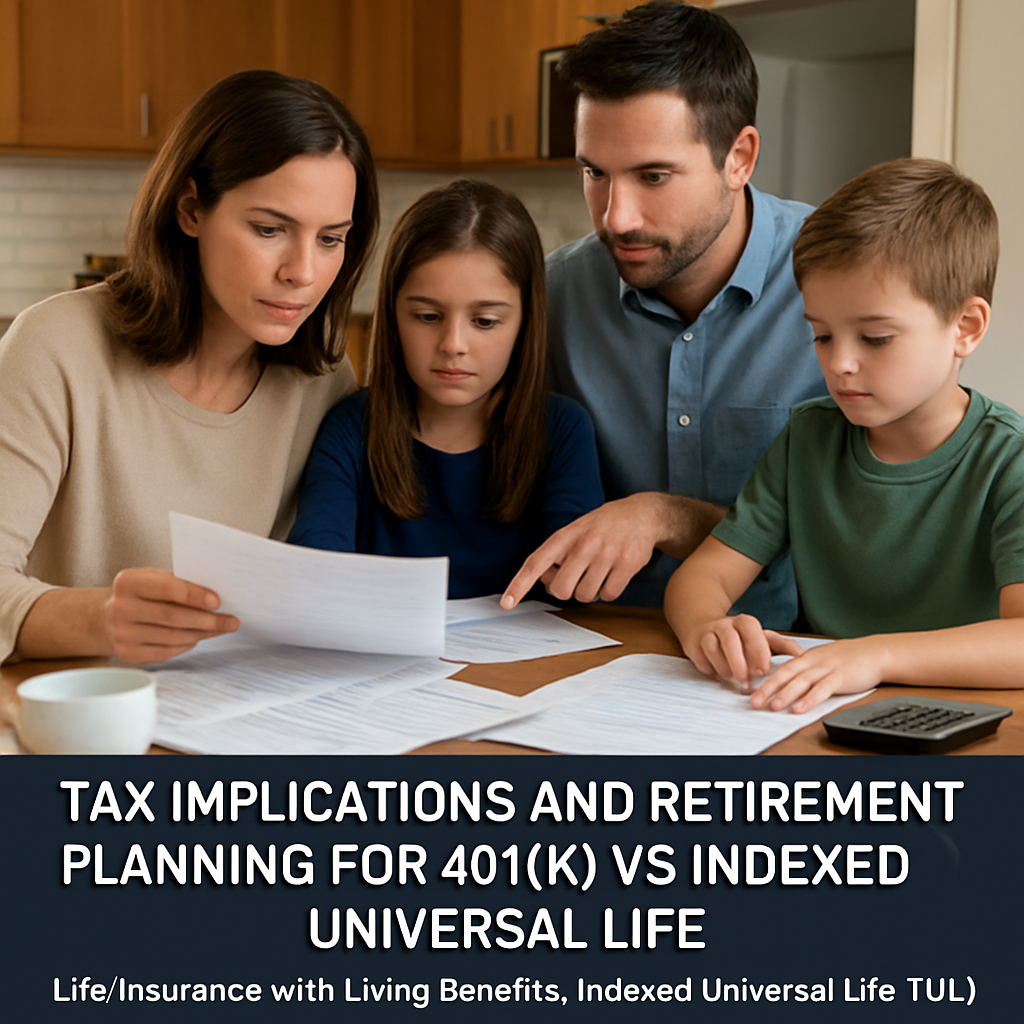
Bottom line: understanding the tax mechanics of each tool lets you design a retirement plan that feels personal, not generic. Whether you’re just starting out or fine‑tuning a legacy strategy, think of the 401(k) and IUL as complementary pieces of a puzzle rather than competing products.
Ready to see how the numbers play out for your situation? A quick call with a licensed advisor can map out the exact tax impact and help you decide how much to allocate to each bucket.
Choosing the Right Solution for Homeowners, Teachers, and Small Business Owners
Imagine you’re a homeowner juggling a mortgage, a teacher balancing a classroom budget, or a small‑business owner watching cash flow like a weather‑front. You’ve already heard the buzz about 401k vs indexed universal life, but now you need to decide which tool actually fits the life you lead.
Who Benefits Most from a 401(k)?
If you love the idea of “set it and forget it,” the 401(k) feels familiar. It’s payroll‑deducted, often comes with an employer match, and the contribution limits are crystal‑clear – $23,500 for 2025 plus a $7,500 catch‑up if you’re 50 or older. For a teacher earning $55,000, that match alone can add a few thousand dollars a year you’d never see otherwise.
But the 401(k) also comes with strings. Early withdrawals trigger a 10 % penalty plus ordinary income tax, and once you hit 73 the IRS forces you to take RMDs, which can push you into a higher tax bracket. If you’re already stretched thin covering property taxes or student‑loan payments, those mandatory pulls might feel like an unwelcome surprise.
Who Finds an IUL More Attractive?
An Indexed Universal Life (IUL) policy is a bit like a flexible credit line that grows with the market while never letting you lose money when the market dips. That floor is priceless for a small‑business owner who can’t afford a sudden dip in retirement savings right before a big inventory purchase.
Because premiums are flexible, you can start modestly while you’re getting the business off the ground, then ramp up contributions as cash flow improves. The cash‑value builds tax‑deferred, and you can tap it with policy loans that aren’t considered taxable income – perfect for a homeowner who wants to pull $20,000 for a kitchen remodel without opening a 401(k) withdrawal window.
And remember, the death benefit stays intact as long as the policy is in force, offering a legacy safety net that a 401(k) can’t match without a complicated beneficiary strategy.
Key Decision Factors to Weigh
- Liquidity Needs: Do you expect to need cash before retirement? IUL loans give you that freedom; 401(k) withdrawals are penalized.
- Tax Situation Today vs. Later: If you’re in a low bracket now, pre‑tax 401(k) contributions make sense. If you anticipate a higher bracket in retirement, the tax‑free IUL loan can keep more money in your pocket.
- Employer Match: Never leave free money on the table. Grab the full match before you start layering an IUL.
- Risk Tolerance: Comfortable riding market swings? A 401(k) invested in stocks may outpace an IUL cap. Prefer the safety of a 0 % floor? The IUL wins.
- Legacy Goals: Want a tax‑free inheritance? The IUL’s death benefit is designed for that.
Practical Checklist for Your Situation
Grab a pen and run through these items tonight. It only takes a few minutes and can save you years of regret.
- Confirm your employer’s match formula. Contribute at least enough to capture 100 % of the match.
- Project your retirement taxable income. If you see yourself in the 24 % bracket, consider earmarking extra cash for an IUL premium.
- Estimate the cash‑value you could build by age 60 with a modest $2,000 monthly premium. Use the illustration your agent provides.
- Run a “what‑if” scenario: withdraw $15,000 from the 401(k) versus take a $15,000 IUL loan. Compare the tax hit and impact on your death benefit.
- Check your business cash‑flow calendar. Identify months where an IUL loan could smooth out payroll or inventory purchases without hurting your bottom line.
- Schedule a quick call with a licensed advisor. In our experience, a 20‑minute conversation can pinpoint the exact premium you need to keep the policy in force while still leaving room for growth.
So, where does that leave you? If you’re a homeowner who values a predictable match and can tolerate the RMDs, lock in the 401(k) first, then layer an IUL for that extra tax‑free cushion. If you’re a teacher eyeing a stable cash reserve for summer expenses, the IUL’s loan feature might be your secret weapon. And if you run a boutique bakery or a tech start‑up, the IUL can act like a reserve fund that never forces you to sell assets at a bad time.
Bottom line: there’s no one‑size‑fits‑all answer. The sweet spot often looks like a hybrid – a solid 401(k) foundation paired with a carefully sized IUL that matches your liquidity, tax, and legacy priorities. Take the time now to map those priorities, run the numbers, and you’ll walk into retirement feeling confident, not confused.
Real-World Scenarios and Case Studies
Family‑friendly cash‑flow story
Imagine the Martinez family from our earlier example, but this time they also have a preschool tuition bill that spikes every September. They’ve maxed out their 401(k) match, yet they still need a few thousand dollars to keep the school seats.
What we often see is the IUL loan stepping in like a quiet helper. They borrow $12,000 at a modest interest rate, pay it back over five years, and the loan never shows up as taxable income. Meanwhile, their 401(k) keeps growing tax‑deferred for long‑term retirement.
Does that feel like a win? For many families, yes – the loan smooths the cash‑flow crunch without forcing them to tap the 401(k) early and incur penalties.
Teacher juggling summer bills
Sarah, a 35‑year‑old teacher, loves the summer break but dreads the sudden dip in paycheck. She contributes $5,000 a year to her 401(k) and captures the full employer match. However, the summer months leave her $3,000 short for a home‑repair project.
She sets up an IUL with a $1,500 monthly premium, builds cash value slowly, and when summer arrives she takes a $2,500 policy loan. Because the loan is tax‑free and doesn’t shrink her death benefit (as long as she pays interest), she avoids a stressful payday loan.
So, should every teacher add an IUL? Not automatically – it depends on how comfortably they can afford the premium while still meeting other goals.
Small‑business owner’s surprise
Mike runs a boutique bakery. His cash‑flow calendar shows a heavy ingredient purchase in March and a lull in July. He’s already contributing the maximum to his solo 401(k) and loves the employer‑match‑free “extra” money.
When a supplier offers a 30‑day credit line, Mike decides to tap his IUL cash value instead of borrowing from the bank. He draws $20,000, pays the loan interest from the bakery’s profits, and keeps his 401(k) untouched for retirement.
Later, the bakery’s revenue spikes, and the loan is paid off early. The lesson? An IUL can act like a revolving line of credit for business owners who need flexibility without jeopardizing retirement assets.
When an IUL doesn’t work out
Not every IUL story ends in a happy loan. Take the cautionary tale from the White Coat Investor: a policyholder paid $24,000 in premiums, watched the cash value shrink to $6,000, and faced a cumulative -75% return.Read the full breakdown here. The policy’s high fees and low participation rate meant the loan feature never became useful.
What should you do if the numbers look this bleak? First, request an in‑force illustration from your agent. If projected returns stay below the cost of insurance, consider surrendering the policy or swapping it for a low‑cost variable annuity – but only after you’ve confirmed the tax impact.
Bottom line: real‑world outcomes hinge on three things – the discipline to fund the premium, the policy’s fee structure, and a clear plan for when you’ll actually need the loan.
Quick checklist for your own scenario
- Map out the months where cash is tight (payroll, tuition, inventory).
- Calculate the premium you can comfortably afford without choking other goals.
- Run an in‑force illustration that shows cash‑value growth under modest, flat, and high‑cap scenarios.
- Compare the projected loan amount to your anticipated short‑term needs.
- If the illustration looks weak, explore other tax‑free vehicles (e.g., Roth conversions or a low‑cost annuity).
By walking through these steps, you’ll see whether the 401k vs indexed universal life debate tips in favor of a hybrid approach or leans toward one tool alone.
FAQ
What is the main difference between a 401(k) and an indexed universal life (IUL) policy?
A 401(k) is an employer‑sponsored retirement account that lets you defer taxes on contributions and earnings until you withdraw them. An IUL, on the other hand, is a permanent life‑insurance contract that builds cash value tied to a market index, while also providing a death benefit. The key contrast is how you access money: 401(k) withdrawals are taxable and may incur penalties, whereas an IUL lets you borrow against the cash value tax‑free (as long as the policy stays in force).
Can I use an IUL loan to cover unexpected expenses without hurting my retirement plan?
Absolutely. Because the loan is taken against your own cash value, the IRS doesn’t treat it as taxable income. You’ll pay interest to the insurer, and any unpaid balance reduces the death benefit, but your 401(k) can stay untouched, continuing to grow tax‑deferred. In practice, families use IUL loans for things like home‑repair costs, tuition spikes, or a short‑term business cash‑flow crunch, keeping their retirement nest egg intact.
How does the “floor” in an IUL protect me compared to a regular 401(k) investment?
Most IUL contracts guarantee a 0 % floor on the credited interest each policy year. That means even if the linked index falls, your cash value won’t lose money because of market drops. A 401(k) invested in stocks or bond funds doesn’t have that safety net—if the market slides, your account balance follows suit. The trade‑off is that IULs also cap upside gains, usually around 10‑12 %.
Do I lose the employer match if I add an IUL on top of my 401(k)?
No, you don’t. The employer match is a separate contribution that stays in the 401(k) plan. Adding an IUL simply gives you another bucket for retirement savings. The best practice is to first capture 100 % of the match—because it’s free money—then consider directing any extra cash toward an IUL premium, especially if you value tax‑free liquidity later on.
What happens to my IUL if I stop paying premiums?
Most IULs offer flexible premium options, but if you let payments lapse for too long the cash value can be drained by the cost‑of‑insurance charges, eventually causing the policy to lapse. That would erase both the death benefit and any accumulated cash value. To avoid this, schedule a premium review at least annually and adjust the payment amount to stay ahead of the rising insurance cost as you age.
Are there any tax penalties for borrowing from an IUL?
Generally, no. As long as the policy remains in force and you don’t exceed the loan amount over the cash value, the loan is considered a non‑taxable distribution. The only “cost” is the interest you pay to the insurer, which is usually lower than the tax you’d owe on a 401(k) withdrawal. However, if the loan grows too large, it could trigger a taxable event when the policy lapses.
How do I decide whether the 401(k) or IUL should be the primary retirement vehicle for my family?
Start by listing your top three goals: tax efficiency, liquidity, and legacy protection. If you need guaranteed employer‑matched growth and can tolerate RMDs, the 401(k) should be the foundation. If you want a tax‑free safety valve for cash‑flow gaps or a death benefit for loved ones, layer an IUL on top. In our experience, families who blend both end up with a more resilient retirement plan that adapts to life’s curveballs.
Conclusion and Next Steps
We’ve walked through the nitty‑gritty of 401k vs indexed universal life, and you probably feel a mix of excitement and a little overwhelm. That’s normal – blending a traditional retirement account with a flexible life‑insurance cash engine isn’t a one‑size‑fits‑all decision.
So, what’s the next move? First, grab a notebook and list your top three priorities: tax efficiency, liquidity, or legacy protection. Then, match each priority to the strengths we’ve highlighted – the employer match and high contribution limits for a 401k, the tax‑free loan option and the death‑benefit cushion for an IUL.
Next, run a quick side‑by‑side snapshot. Project your 401k balance at age 73, estimate the cash value you could build in an IUL by age 60, and see how a modest loan would affect both your taxable income and your beneficiaries.
If the numbers line up, schedule a brief, no‑obligation consultation with a licensed advisor. In our experience, a 20‑minute chat can clarify premium flexibility, cost‑of‑insurance charges, and the exact loan interest rate you’d face.
Remember, the goal isn’t to pick a winner; it’s to create a resilient retirement plan that works for your family’s unique story. Take the first step today and turn that plan into peace of mind.