


Ever sat at your kitchen table, scrolling through endless insurance forms, and thought, “Will you ever find a quote that actually makes sense for my family?” You’re not alone. We get it because the jargon can feel like a maze, and the numbers on a quote often look like a foreign language.
We get it because we’ve helped dozens of families, teachers, and small‑business owners untangle those confusing pages. The first thing we tell them is that an indexed universal life (IUL) quote isn’t just a price tag—it’s a snapshot of how the policy could grow with market indexes while protecting your loved ones if the unexpected happens.
So, what should you be looking at when that quote lands in your inbox? Start with the premium amount, but don’t stop there. Ask yourself: does the quote show the potential cash‑value accumulation linked to an index like the S&P 500? Is there a clear illustration of the floor protection that keeps the cash value from dropping below zero even when markets dip?
Imagine you’re a homeowner protecting a mortgage. A well‑structured IUL quote will outline a “living benefit” that could be used to pay off that loan if you become disabled. For a teacher thinking about retirement, the same quote should highlight tax‑free growth potential that can supplement a pension.
One common mistake is focusing only on the initial cost. An IUL quote often includes flexible premium options, so you can adjust contributions as your budget changes. Look for language that explains how the policy can adapt—whether you need to increase payments during a high‑earning year or scale back when you’re nearing retirement.
Feeling a bit overwhelmed? That’s normal. The good news is you don’t have to navigate this alone. A quick call with a licensed advisor can turn that dense document into a clear roadmap, showing you exactly how the indexed component works, what the caps and participation rates mean, and how the living benefits fit your life plan.
Ready to take the next step? Grab a fresh, personalized indexed universal life insurance quote today and see how the numbers line up with your goals. Let’s demystify the process together.
TL;DR
Indexed universal life insurance quotes break down growth caps, floor protection, and living benefits so you can see how a policy fits your budget and goals.
A call with a licensed advisor at Life Care Benefit Services turns those numbers into a roadmap, guiding you toward retirement income and premiums.
Understanding Indexed Universal Life (IUL) Insurance Basics
Okay, picture this: you’ve just gotten an IUL quote in your inbox. It’s got a bunch of numbers, a few buzzwords, and a promise that your cash value can grow with the market—but without the scary downside of losing it all if the S&P 500 tanks. Sound familiar?
First off, an IUL is a type of permanent life insurance. That means, unlike term policies that disappear after a set number of years, this one stays in force as long as you keep up the premiums. The “indexed” part is what makes it unique: the cash‑value growth is tied to a stock market index, yet the policy itself never actually invests directly in the market.
So how does that work? The insurance company takes the index’s performance, applies a participation rate (maybe 80 % of the index’s gain), and then caps the upside at a predetermined limit—often called the cap. If the index goes up 10 %, you might see 8 % credited to your cash value. If it drops 5 %, you’re protected by a floor, usually 0 %, meaning you won’t lose any of the cash you’ve already built.
Imagine you’re a homeowner who just paid off a mortgage. You could use the cash value in your IUL to fund a home renovation, pay for college tuition, or even supplement retirement income—tax‑free, as long as you follow the rules. That flexibility is why many families, teachers, and small‑business owners keep coming back to this product.
Now, let’s break down the three pieces you’ll see on any quote:
- Premium amount: The base cost you pay each month or year. IULs often allow flexible premiums, so you can bump them up when you have extra cash and pull back during tighter months.
- Cap and participation rate: These dictate how much of the index’s upside you actually capture. Higher caps mean more potential growth, but they can also come with higher costs.
- Floor protection: Usually a 0 % floor, meaning your cash value won’t shrink because of market downturns. It’s the safety net that makes the “indexed” label feel less risky.
Does that sound a bit like a balancing act? It is. The art is in finding the right mix of cap, participation, and premium that matches your financial goals.
One thing many people overlook is the policy’s “living benefits.” These are riders that let you tap into the cash value if you become disabled, need long‑term care, or face a serious illness. For a teacher who worries about future health costs, that rider can be a game‑changer.
And here’s a quick tip: when you’re reviewing a quote, ask the advisor to run a “scenario analysis.” That’s a simple spreadsheet that shows how the cash value could look after 10, 20, or 30 years under different market conditions. It turns the abstract numbers into a picture you can actually see.
Speaking of advisors, our team at Life Care Benefit Services often walks clients through that exact exercise. We’ve seen families who thought the premium was too high, only to discover that the flexible payment options let them start small and grow the policy as their income rises.
Notice how the video walks through a real‑life quote example—watching it can make those caps and floors feel less like jargon and more like tools you control.
When you’re ready to dig deeper, think about these three questions:
- Do I need flexible premiums to match my cash flow?
- What cap level feels comfortable for my growth expectations?
- Which living‑benefit riders align with my family’s health concerns?
Answering them will give you a solid foundation before you sign anything.
Finally, remember that an IUL isn’t a one‑size‑fits‑all product. It shines when you want a blend of life‑insurance protection, market‑linked growth, and the ability to pull money out for real‑world needs without tax penalties. If that sounds like you, a personalized quote can show exactly how the numbers line up with your budget and long‑term plans.
Take a moment now to jot down your top three financial goals—whether it’s protecting a mortgage, funding a child’s education, or building a tax‑efficient retirement nest egg. Bring that list to your next conversation with an advisor, and you’ll walk away with a quote that actually talks to your life.
Ready to see those numbers in plain English? Let’s get you that customized IUL illustration.

How IUL Quotes Are Calculated: Key Factors to Consider
When the quote lands in your inbox, it can look like a spreadsheet of mystery numbers. You’re probably thinking, “Which of these actually matters to my budget and my future?” Let’s walk through the parts that really move the needle.
The building blocks of an IUL quote
First, every indexed universal life insurance quote breaks down into three core sections: the premium schedule, the cost‑of‑insurance (COI) charges, and the indexed credit assumptions. The premium is the amount you agree to pay each month or year. The COI covers the death‑benefit protection and varies with your age, health and the amount of coverage you choose. The indexed credit is where the market‑linked upside (and the floor) lives.
Does that sound familiar? It’s the same layout you saw in the video earlier – just stripped down to the math.
Crunching the numbers: how premiums and costs are calculated
Premiums start with a base rate that the insurer derives from actuarial tables. Add to that any riders you’ve selected – like an accelerated death‑benefit rider for disability – and you get the “gross premium.” From there, the insurer subtracts the COI and any administrative fees. What’s left fuels the cash‑value bucket.
Here’s a quick reality check: if your COI climbs faster than the cash value can grow, the policy could lapse unless you increase your payments. That’s why the quote will usually show a “minimum premium” needed to keep the policy in force.
What the caps, floors & participation rates really mean
Now the part that makes IULs different from a regular universal life: the indexed credit. The insurer picks an index (often the S&P 500) and applies three knobs – the floor, the cap, and the participation rate. The floor (usually 0 %) guarantees you won’t lose cash value when the market drops. The cap limits the upside – say 10 % – so even if the index jumps 15 %, you only get credited 10 %.
The participation rate tells you what slice of the index’s gain you actually capture. A 80 % participation on a 6 % index rise translates to a 4.8 % credit, before the cap is applied. NerdWallet breaks down these mechanics nicely here, and Western & Southern gives a plain‑English view of caps and floors there.
So, when you stare at the quote, ask yourself: “Is the participation rate high enough for my risk appetite? Is the cap realistic given historical market returns?”
Tips for comparing quotes
1️⃣ Look beyond the headline premium. A lower premium might hide a higher COI or a tighter cap.
2️⃣ Run a stress test. Imagine a year where the index returns 0 % – will the floor keep the cash value from eroding?
3️⃣ Check rider costs. A living‑benefit rider can add $10‑$20 per month, but it might be priceless if you need it.
4️⃣ Verify the policy’s flexible‑premium feature. You should be able to boost payments in a high‑earning year without re‑underwriting.
5️⃣ Ask for a side‑by‑side table – that’s where the comparison table below comes in handy.
| Factor | What It Affects | What To Look For |
|---|---|---|
| Premium (gross) | Monthly cash outflow & cash‑value buildup | Ensure it fits your budget; watch for hidden rider fees |
| Cost‑of‑Insurance (COI) | Long‑term policy sustainability | Check age‑based escalation; compare across insurers |
| Cap, Floor & Participation | Potential indexed credit & growth ceiling | Higher participation & reasonable cap = more upside; floor should be ≥0 % |
Bottom line: a solid IUL quote is a balance of affordable premiums, manageable COI, and realistic indexed assumptions. Take the time to dissect each line, run a few “what‑if” scenarios, and don’t be shy about asking your advisor to walk you through the numbers.
Ready to put the math to work for you? Grab a fresh quote, run the checklist, and see if the numbers line up with your retirement or mortgage‑protection goals.
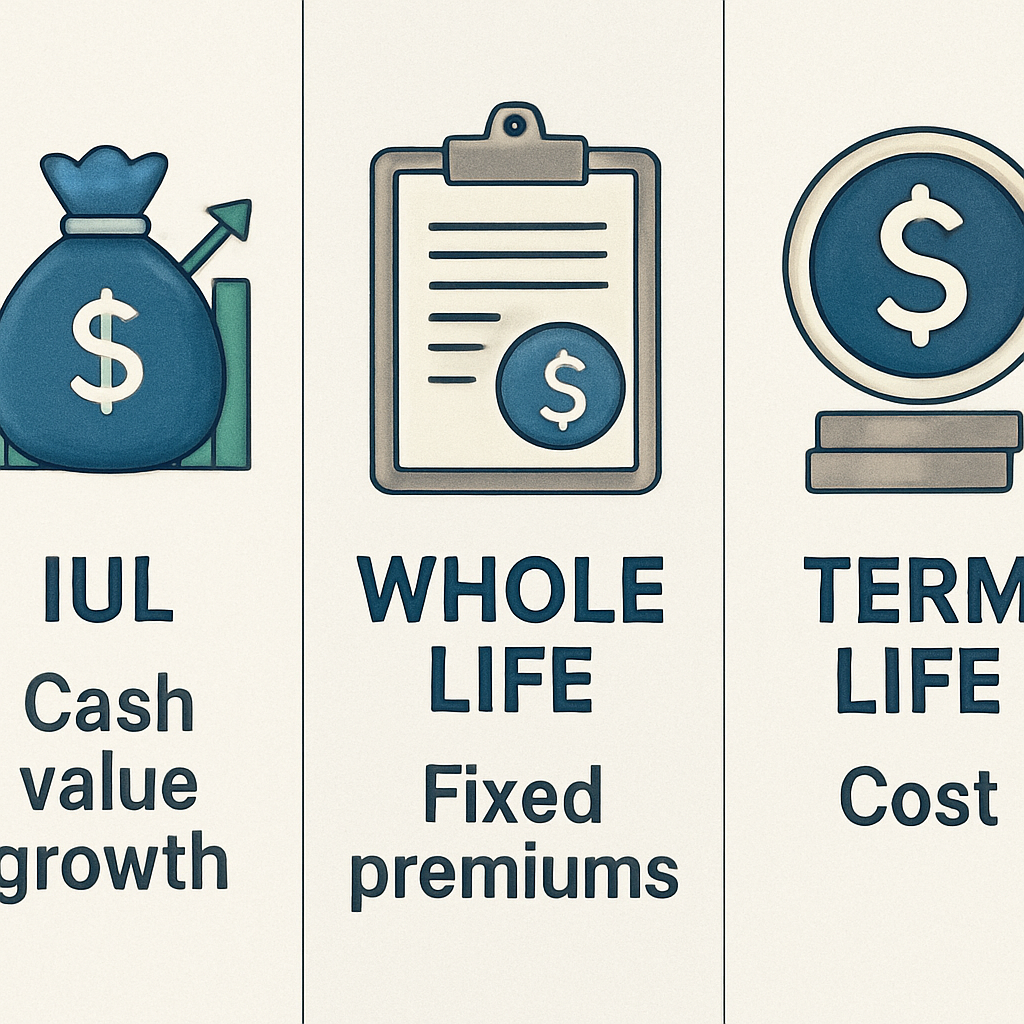
Comparing IUL with Traditional Whole Life and Term Policies
So you’ve got an indexed universal life insurance quote in front of you and you’re wondering how it really stacks up against the more familiar whole‑life and term options. It’s a fair question – after all, each product promises protection, but they move very differently under the hood.
What makes IUL stand out?
IULs are permanent policies, like whole life, but the cash‑value growth is tied to a market index instead of a fixed interest rate. That means you can capture upside when the market climbs, yet the floor (usually 0 %) protects you from losing cash value when it dips. Whole life, on the other hand, guarantees a modest, predictable cash‑value increase, and term offers no cash value at all.
In our experience, families who want a blend of lifelong coverage and growth potential gravitate toward IULs because the flexibility matches changing budgets – you can raise or lower premiums without re‑underwriting.
Whole Life vs. IUL: the trade‑offs
Whole life gives you a locked‑in premium for life and a guaranteed cash‑value buildup, which can be reassuring if you dislike market uncertainty. The downside is that the guaranteed rate is usually lower than what a well‑designed IUL can achieve over a 20‑year horizon.
Imagine a couple in their early 40s, Sarah and Tom, who want to protect their mortgage and also build a retirement supplement. A whole‑life quote might show a $250 monthly premium with a guaranteed 2.5 % cash‑value credit. Their IUL quote, however, could start at $230 per month, with a participation rate of 70 % on the S&P 500 and a 9 % cap. If the index averages 6 % a year, the IUL could end up delivering roughly 4 % annual growth – a noticeable edge over the whole‑life guarantee.
But there’s a catch: IUL performance depends on the insurer’s cap and participation settings. If the cap is too low, you might never see the upside you expect. That’s why it’s crucial to compare the cap, floor, and participation side‑by‑side – something the Western & Southern guide walks through in plain language.
Term Life vs. IUL: cost and flexibility
Term life is the budget‑friendly option. Premiums are usually a fraction of what permanent policies charge because you’re only buying protection for a set period, say 20 or 30 years. No cash value means no tax‑deferred growth, but the lower cost can free up money for other goals, like a 529 plan or a Roth IRA.
Let’s say a small‑business owner, Maya, needs coverage for a key‑person loan that expires in 15 years. A 15‑year term policy might cost her $80 a month for a $500,000 death benefit. An IUL with the same face amount could run $150‑$180 a month, but it also builds cash value that Maya could tap to fund a buy‑sell agreement later on. If she never needs the cash value, the term policy wins on price. If she does, the IUL’s flexibility could save her a lot in the long run.
The Capital for Life comparison highlights that trade‑off clearly: term is cheaper, IUL offers lifelong protection plus growth potential.
Actionable checklist when you compare quotes
- Write down the premium for each policy and note whether it’s fixed (whole life) or flexible (IUL).
- Check the IUL’s participation rate, cap, and floor. Higher participation and a reasonable cap usually mean more upside.
- Look at the whole‑life guaranteed interest rate – is it enough to meet your cash‑value goals?
- Calculate the cost‑of‑insurance (COI) for the IUL; it climbs with age and can erode cash value if you’re not careful.
- Consider your time horizon. If you need protection for only a specific debt, term may be sufficient. If you want a legacy plus a retirement supplement, IUL or whole life make more sense.
Take a moment to run a simple “what‑if” scenario: plug a 0 % index year into the IUL illustration. Does the floor keep the cash value from shrinking? If the answer is yes, you have a built‑in safety net that term simply can’t provide.
Finally, remember that no single policy fits everyone. Your choice should reflect how you view risk, how long you plan to keep the coverage, and whether you value the cash‑value component as a living benefit.
When you sit down with a licensed advisor, bring these points to the table. Ask for a side‑by‑side comparison chart that highlights premium, COI, cap, floor, and participation. That visual will make the differences crystal clear.
Choosing between IUL, whole life, and term is less about “which is best” and more about “which aligns with your life story.”
Now that you’ve got the framework, the next step is to pull the three quotes, line them up, and see which one feels right for your family, your business, or your retirement plan.
Getting Your Personalized IUL Quote: Step-by-Step Process (Video Walkthrough)
Alright, you’ve made it past the jargon jungle and you’re ready for a real‑world quote. The good news? The whole thing can be broken down into a handful of bite‑size steps, and you can watch a quick video that walks you through each screen.
Step 1: Gather Your Basics
Before you even click “Start Quote,” pull together the info you’ll need: your date of birth, current health snapshot (any recent check‑ups or chronic conditions), and the death‑benefit amount you’re comfortable with. For families, think about the mortgage balance or tuition costs you’d want covered. For small‑business owners, jot down the key‑person coverage amount you’d need for a buy‑sell agreement.
Having these numbers on hand saves you from pausing mid‑video to hunt for paperwork.
Step 2: Choose the Right Index
The video will show you a dropdown of popular indexes – S&P 500, Nasdaq‑100, or a blended option. Each comes with its own participation rate, cap, and floor. Remember, the floor is usually 0 % – that’s the safety net that keeps your cash value from shrinking when the market dips.
If you’re not sure which index fits your risk appetite, picture this: Sarah (a homeowner) liked the S&P 500 because she wanted solid growth, while Mark (a teacher) picked the Nasdaq‑100 for a bit more upside. Both kept the 0 % floor, so they felt protected.
Step 3: Plug in Premium Preferences
The walkthrough asks whether you want a fixed premium or a flexible one. Flexible premiums let you increase contributions in a high‑earning year or dial them back when cash flow tightens. The video demonstrates how the premium schedule adjusts the projected cash‑value bucket.
Tip: start with a premium you can comfortably afford now; the policy can often become “zero‑cost” later when cash value covers the cost‑of‑insurance (COI).
Step 4: Review Riders and Living Benefits
Riders are optional add‑ons – think accelerated death benefit for disability, or a long‑term care rider. The video will pop up a checklist; tick the ones that match your life stage. For example, a small‑business owner might add a key‑person rider, while a senior could add a long‑term care rider to protect retirement assets.
Each rider adds a small monthly charge, but the peace of mind can be priceless if the scenario ever plays out.
Step 5: Run the Illustration
Now the video shows the illustration screen. Here you’ll see three columns: premium outflow, COI, and indexed credit (participation × index gain, capped at the policy’s limit). The illustration projects cash value at ages 30, 40, 50, and 65.
Look for two red flags: a cash‑value projection that dips below the premium floor, or a COI that grows faster than the indexed credit. If either shows up, you may need a higher participation rate or a larger cap.
Step 6: Ask for a Side‑by‑Side Comparison
Most agents will gladly pull a second quote with a different index or carrier. The video reminds you to request a side‑by‑side table so you can compare premium, COI, cap, floor, and participation at a glance.
When you have both, run a quick “what‑if” scenario: set the index return to 0 % for a year and see if the floor keeps the cash value stable. If it does, you’ve got the built‑in safety net that term life can’t offer.
Step 7: Finalize and Schedule a Call
Once you’ve walked through the video and feel good about the numbers, hit the “Request Personal Quote” button. An advisor from Life Care Benefit Services will reach out, verify the data you entered, and fine‑tune any rider selections.
During the call, ask them to walk you through the illustration line‑by‑line – they’ll point out where the cap might limit growth and where the floor protects you.
Quick Checklist to Keep Handy
- Birthdate, health snapshot, and desired death benefit amount.
- Preferred index (S&P 500, Nasdaq‑100, blended) and its participation rate.
- Premium style – fixed vs. flexible.
- Riders you need (disability, long‑term care, key‑person).
- Side‑by‑side comparison of at least two quotes.
- Stress‑test the illustration with a 0 % index year.
Following these steps, the video becomes less of a mystery and more of a guided tour. You’ll walk away with a personalized, data‑driven IUL quote that actually makes sense for your family, your business, or your retirement plan.
Need a refresher on how the indexed credit works? Progressive’s explainer breaks down the floor, cap, and participation concepts in plain language.
Ready to hit that “Get My Quote” button? Grab a pen, watch the walkthrough, and let’s turn those numbers into a clear path forward.
Living Benefits and Retirement Planning with IUL
When you think about retirement, the first thing that comes to mind is usually a 401(k) or a pension. But what if you could also have a death‑benefit safety net and a tax‑free source of cash that you can tap in the years before you stop working? That’s exactly what the living‑benefit side of an indexed universal life (IUL) policy offers.
The core idea is simple: the policy builds cash value by crediting interest linked to a market index, while a floor—usually 0 %—protects you from any market‑down loss. Those dollars sit in a separate bucket that you can withdraw, take a loan against, or use to pay a qualified expense without triggering ordinary income tax. In practice, that means you could supplement your retirement income, cover a long‑term‑care bill, or even pay off a mortgage if life throws you a curveball.
Let’s look at three real‑world scenarios that illustrate how the living benefits work in everyday life.
Scenario 1: Mortgage protection for a growing family
Emily, a 38‑year‑old homeowner, bought a $300,000 IUL with a 6 % participation rate on the S&P 500 and a 9 % cap. After ten years the cash‑value projection in her illustration shows about $45,000. If she were to become disabled, the accelerated death‑benefit rider would let her access that $45,000 tax‑free to cover the remaining mortgage balance. The floor guarantees the cash value never dips below zero, so even a flat market year doesn’t erode the protection she’s counting on.
Scenario 2: Retirement supplement for a teacher
Mark, a high‑school teacher nearing 60, already maxes out his 401(k). His IUL quote lists a $150 monthly premium, a 4 % participation rate on the Nasdaq‑100, and a 7 % cap. By age 65 the policy projects roughly $80,000 of cash value. Mark can withdraw $5,000‑$6,000 per year, tax‑free, to top up his modest pension. Because the policy’s cost‑of‑insurance (COI) is covered once the cash value reaches a certain level, those withdrawals become essentially a zero‑cost retirement supplement.
Scenario 3: Key‑person coverage for a small business
Lisa runs a boutique graphic studio with a partner. They purchase a $500,000 IUL with a blended index, 5 % participation, and a 12 % cap. The policy’s cash value grows to $120,000 by year 12. When the partnership agreement calls for a buy‑sell buy‑out, Lisa can use the cash value or take a policy loan to fund the purchase, avoiding a costly bank loan. The living‑benefit rider also provides accelerated death benefit if either partner faces a serious illness, keeping the business afloat.
Notice how each example leverages the same three levers—participation rate, cap, and floor—to shape a different financial outcome. The numbers on an indexed universal life insurance quote aren’t just abstract; they tell you exactly how much you could withdraw in a retirement year or how much you could use to protect a mortgage.
How to turn an IUL quote into a retirement‑ready plan
- Start with your retirement cash‑flow goal. Estimate how much extra income you’d like each year after age 65.
- Ask your advisor to run a “what‑if” scenario where the index returns 0 % for a year. Verify the floor keeps the cash value from shrinking.
- Compare the participation rate and cap across at least two carriers. Higher participation plus a realistic cap (8‑12 %) usually yields the best upside.
- Check the cost‑of‑insurance schedule. Make sure the projected cash value will eventually cover the COI so the policy can become “zero‑cost” in retirement.
- Consider adding an accelerated death‑benefit rider or a long‑term‑care rider if you want extra protection. Those riders typically cost $10‑$20 per month but can be priceless when needed.
- Finally, schedule a call with a licensed Life Care Benefit Services advisor and request a side‑by‑side illustration. Our team can walk you through each line item and help you pick the index and rider mix that aligns with your retirement timeline. Learn more about the basics of Indexed Universal Life Insurance (IUL) on our site.
Remember, staying healthy reduces the likelihood you’ll need to tap those benefits early—consider proactive health support from XLR8well.
IUL for Small Business Owners and Teachers: Real-World Scenarios
Picture this: you’re juggling a classroom full of eager minds or steering a boutique graphic studio, and the idea of “what if something happens” keeps tugging at the back of your mind.
That nervous “what‑if” is exactly why many of us start looking at indexed universal life insurance quotes. It’s not just a death benefit – it can become a living‑benefit safety net that grows with the market, yet never lets you lose what you’ve built.
Scenario A – The Teacher Who’s Already Maxed Out Retirement Accounts
Meet Mark, a 58‑year‑old high‑school teacher who’s been contributing the max to his 403(b) for years. He’s comfortable with his pension, but he wants a tax‑free supplement for the next decade.
Mark’s IUL quote shows a $150 monthly premium, a 4 % participation rate on the Nasdaq‑100, and a 7 % cap. The illustration projects roughly $80 000 of cash value by age 65.
Because the policy’s cost‑of‑insurance eventually gets covered by that cash value, Mark can start taking tax‑free withdrawals of $5 000–$6 000 a year without touching his pension.
Does this sound like a stretch? In fact, high‑income professionals often find IUL a good fit when they’ve already maxed out other tax‑advantaged accounts.
Scenario B – The Small‑Business Owner Who Needs Key‑Person Protection
Lisa runs a boutique graphic studio with a partner. Their biggest worry? What happens to the business if one of them can’t work.
Lisa’s IUL quote lists a $300 monthly premium, a $500 000 death benefit, a blended index with a 5 % participation rate and a 12 % cap. By year 12 the cash value sits around $120 000.
When the partnership agreement triggers a buy‑sell clause, Lisa can either take a policy loan or cash out that $120 000 to buy out her partner, avoiding a costly bank loan.
The accelerated death‑benefit rider also gives her a safety net if a serious illness strikes – the cash value can be accessed tax‑free to keep the studio running.
Scenario C – The Teacher‑Entrepreneur Balancing Two Worlds
Sarah teaches part‑time and runs an online tutoring business on the side. Her income fluctuates wildly from semester to semester.
Sarah’s IUL quote offers flexible premiums: she can pump $250 a month during peak tutoring months and drop to $100 when school is out. The policy uses the S&P 500 index with a 6 % participation rate and a 9 % cap.
Because the floor is 0 %, even a flat market year won’t shrink her cash value. Over ten years she could amass about $45 000, enough to cover a short‑term disability claim or reinvest in her business.
Quick Checklist – How to Spot the Right IUL Quote for You
- Does the quote show a participation rate that matches your risk comfort? Higher rates = more upside.
- Is the cap realistic compared to historical index returns? Look for 8‑12 % caps for decent growth.
- Check the floor – it should be 0 % or higher to protect against market dips.
- Are flexible premiums listed? That’s a lifesaver for teachers or business owners with irregular cash flow.
- Is an accelerated death‑benefit or key‑person rider included? It can turn a death benefit into a living benefit when you need it most.
So, what’s the next step? Pull a fresh IUL quote, run the “0 % index year” stress test, and compare the participation, cap, and floor side‑by‑side. If the numbers feel comfortable, schedule a quick call with a licensed advisor who can walk you through the illustration line‑by‑line.
Remember, an IUL isn’t a magic bullet, but for teachers who need a tax‑free retirement boost or small‑business owners who need continuity planning, it can be a powerful piece of the puzzle.
FAQ
What exactly are indexed universal life insurance quotes and why do they matter?
Indexed universal life (IUL) insurance quotes are the detailed illustrations you get from a carrier before you sign up. They break down the premium you’ll pay, the cost‑of‑insurance, and the indexed credit assumptions – participation rate, cap and floor – that drive cash‑value growth. Seeing those numbers up front matters because they let you compare how much upside you might capture versus how much protection you keep if the market dips. In short, the quote is your roadmap to a policy that actually fits your budget and goals.
How can I tell if the participation rate in a quote is right for me?
The participation rate tells you what slice of the index’s gain ends up in your cash‑value bucket. A higher rate (like 80‑100 %) means you’ll capture more of the market’s upside, but it can come with a tighter cap. Look at your risk tolerance: if you’re comfortable with a bit more market swing, a higher rate can boost retirement savings. If you prefer steadier growth, a lower rate paired with a generous cap might feel safer. Run a quick “what‑if” – multiply a 6 % index gain by the rate – to see the credit you’d actually earn.
What is a cap and should I be worried if it seems low?
The cap is the maximum credit you’ll receive in any given crediting period, even if the index climbs higher. A cap of 9 % means that even a 12 % market jump only gives you 9 % credit. A lower cap can limit upside, but it also protects the insurer from paying out extreme gains, which can keep premiums stable. Compare the cap to historic index returns – most 20‑year averages sit around 7‑9 %. If the cap is noticeably below that, you might want to shop around for a quote with a more competitive ceiling.
Why is the floor so important in an IUL quote?
The floor is the safety net that guarantees your cash value won’t shrink when the index posts a negative return. Most IULs set the floor at 0 %, meaning you won’t lose money in a down market, though you also won’t earn interest that year. Some carriers offer a modest positive floor (like 1 %), which can add a tiny boost in flat years. When you compare quotes, make sure the floor is at least 0 % – anything lower would defeat the purpose of an IUL’s “no‑loss” promise.
How do flexible premiums work and can they really help my cash flow?
Flexible premiums let you adjust how much you pay month to month, within limits set by the policy. If you have a high‑earning year, you can pump extra money in to accelerate cash‑value growth; if cash gets tight, you can scale back to the minimum required to keep the policy in force. This flexibility is a lifesaver for teachers on a summer break or small‑business owners with seasonal revenue. Just keep an eye on the “minimum premium” line in the quote – dropping below that can cause a lapse.
What riders should I consider adding to my IUL quote?
Riders are optional add‑ons that tailor the policy to your life stage. An accelerated death‑benefit rider lets you tap the cash value tax‑free if you become seriously ill or disabled – great for families worried about medical bills. A long‑term‑care rider can fund nursing or assisted‑living costs later on. For business owners, a key‑person rider turns the death benefit into a buy‑sell fund. Each rider adds a modest monthly charge (often $10‑$20), so weigh the extra protection against your budget.
How often should I review my IUL quote after the policy is in force?
Even after you’re locked in, life changes – you might get a raise, a new mortgage, or a health shift. Review the illustration at least once a year, focusing on the cost‑of‑insurance trend, the cash‑value projection, and any rider adjustments you’ve made. If the COI is climbing faster than your cash value, consider raising premiums or adjusting the index choice. Annual check‑ins keep the policy from slipping into a “zero‑cost” trap where the cash value can’t cover the insurance cost, ensuring the living benefits stay alive.
Conclusion
We’ve walked through how indexed universal life insurance quotes translate numbers into real protection for families, teachers, and small‑business owners.
At the end of the day, the quote is your roadmap: a premium you can afford, a cost‑of‑insurance you can watch, and the participation, cap, and floor that shape your cash‑value upside.
So, what should you do next? Pull a fresh quote, run the zero‑percent stress test, and make sure the minimum premium line stays above the lapse threshold.
If the numbers feel comfortable, schedule a quick chat with a licensed advisor. They can walk you through rider options, fine‑tune the index choice, and help you set up an annual review routine.
Remember, an IUL works best when you treat it like a living savings account – check it yearly, adjust premiums when you get a raise, and keep an eye on the COI trend.
Ready to turn those figures into financial peace of mind? Grab a personalized quote today and see how the right indexed universal life insurance quote can protect your tomorrow.
Take a few minutes each quarter to compare your illustration against actual market performance. If the index you chose consistently falls short of the cap, consider switching to a blended option that balances growth and protection. This habit keeps your IUL aligned with your long‑term goals and prevents surprises down the road.