

Choosing an IUL policy for retirement income can feel overwhelming. You want tax-free cash later, but the options are confusing. Caps, participation rates, fees, riders… it’s a lot. But the secret is simple: focus on the numbers that actually move the needle. Most people fixate on caps. They don’t. Participation rates and early-year fees matter more. This guide walks you through exactly how to choose an IUL policy for retirement income. You’ll learn the five steps to pick a policy that delivers real, reliable retirement income.
Step 1: Assess Your Retirement Income Needs and Risk Tolerance
Before looking at any policy, you need to know your numbers. How much income will you need in retirement? Start with your current expenses. Then subtract expected Social Security, pensions, and any other guaranteed income. The gap is what your IUL needs to fill. A common rule of thumb is 70-80% of pre-retirement income. But your number may be different. Account for healthcare costs, travel, and inflation.
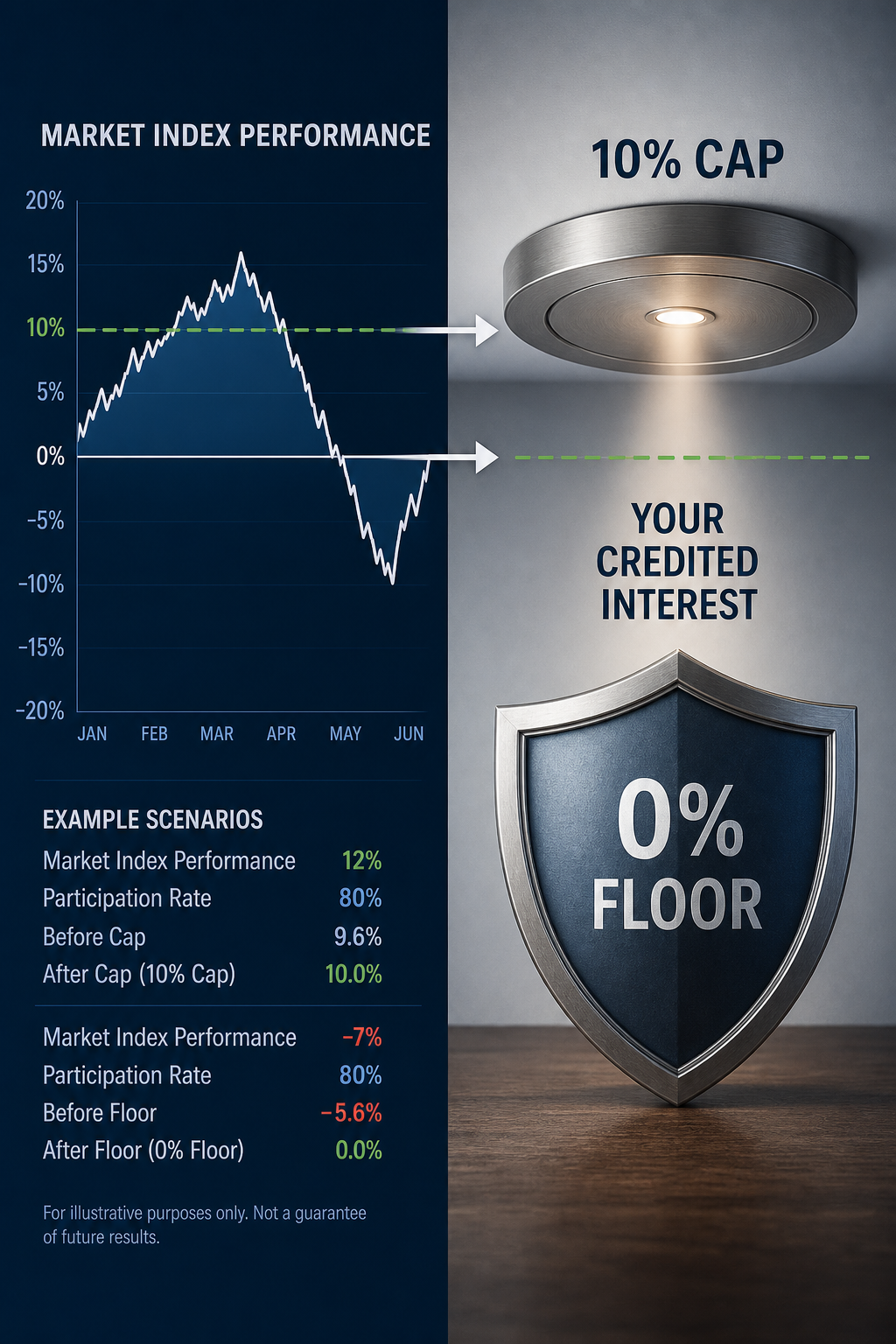
Risk tolerance is the other half. IUL policies tie growth to stock market indexes. But they have a 0% floor. You won’t lose cash value when the market drops. However, growth is capped. If you can’t stomach market volatility, a higher floor (like 1% or 2%) might be worth the trade-off in lower upside. If you want maximum growth, look for high participation rates and moderate caps. Your risk profile directly affects how to choose an IUL policy for retirement income.
Consider your withdrawal timeline. If you’re 10 years from retirement, you have time to ride out market cycles. If you’re already retired, you need more stability. IUL policies allow tax-free loans and withdrawals. But the size of those withdrawals depends on your cash value growth. That’s why understanding your risk tolerance up front is critical when you learn how to choose an IUL policy for retirement income.
Don’t forget about inflation. A dollar today won’t buy the same in 20 years. Look for policies with caps that have historically kept up with or beaten inflation. Many IULs have caps around 10-12%. That’s usually enough to outpace inflation, but check the participation rate too. of IUL mechanics, a higher participation rate has a bigger impact on cash value than a high cap alone. That’s a common misconception.
Also, list your goals. Is this strictly for retirement income? Or do you want to leave a legacy? The death benefit amount affects policy costs. Keep it as low as possible to maximize cash value. For example, a $343,006 death benefit instead of $686,012 for the same premium can free up a lot more money for cash value growth. That’s a huge factor in how to choose an IUL policy for retirement income.
Bottom line: Knowing exactly how much income you need and how much risk you can handle is the first and most important step in how to choose an IUL policy for retirement income.
Step 2: Understand IUL Policy Mechanics, Indexing, Caps, and Floors
IUL policies credit interest based on the performance of a stock market index, like the S&P 500. But there are three key numbers that determine your actual credited interest: participation rate, cap, and floor. The participation rate is the percentage of index gains that get credited to your policy. For example, if the index goes up 10% and your participation rate is 80%, you get credited 8%. Many people overlook this rate and only look at caps. That’s a mistake.
The cap is the maximum interest the policy will credit in a year. If the cap is 12% and the index goes up 15%, you only get 12%. But if the participation rate is low, even a high cap won’t help much. The floor is the minimum interest you’ll earn. Most floors are 0%, meaning you won’t lose cash value when the market drops. Some policies offer a higher floor (like 1% or 2%), but they often have lower caps.
How do these mechanics affect retirement income? A higher participation rate means more of the market’s upside flows into your cash value. Over 20-30 years, that difference compounds significantly. on indexed universal life, front-loaded fees in the early years can also eat into cash value growth. Many buyers assume IULs are low-cost, but they have insurance charges and administrative fees that can be high in the first decade.
When you learn how to choose an IUL policy for retirement income, you must ask for an illustration that shows a 0% index year. See how the floor protects you, and how much the policy costs in that year. Then ask for a 6% average scenario. Compare the net cash value after fees. That’s your real growth.
Also, check the crediting method. Some policies use annual point-to-point, others use monthly averaging. Annual point-to-point is simpler: you get the index return minus the cap and floor. Monthly averaging smooths out volatility but may reduce upside. Choose what fits your comfort level.
Finally, understand that you can choose among several index options. Most policies offer the S&P 500, but some also offer Nasdaq-100, Russell 2000, or a fixed interest account. Diversifying your index choices can reduce risk. But don’t overcomplicate it. Many successful strategies just use the S&P 500 option.
Bottom line: The participation rate, cap, and floor are the levers that drive cash value growth. Prioritize participation rate over cap, and always review fees in your illustrations when you learn how to choose an IUL policy for retirement income.
Step 3: Compare Riders for Retirement, Living Benefits and Income Riders
Riders are optional add-ons that customize your policy. For retirement, the most important ones are living benefits and income riders. Living benefits let you access cash value early if you get sick or disabled. Common riders include accelerated death benefit (terminal illness), chronic illness, and critical illness. These can provide tax-free cash when you need it most, without taking a loan.
Remember the 0% floor? If the market crashes and you need income, you can take cash value from the IUL without selling stocks at a loss. That’s the “volatility sponge” concept. The Overloan Protection Rider is specifically designed to prevent policy lapses if you take aggressive loans. of IUL riders, the overloan protection rider is almost non-negotiable for retirement strategies because it safeguards your income stream.
Income riders guarantee a minimum withdrawal amount for life, regardless of market performance. Not all policies offer them. If you want certainty, look for a Guaranteed Minimum Income Benefit rider. It reduces the risk of outliving your money.
How to choose an IUL policy for retirement income with the right riders: list your main concerns. Is it a chronic illness history in your family? Get the chronic illness rider. Is it running out of money? Get the overloan protection and maybe an income rider. Ask for rider costs. They add a small premium increase, but the security is worth it.
Some companies include a basic accelerated death benefit at no extra cost. Others charge extra. Get a breakdown. Also check if the rider pays out a lump sum or monthly benefits. For retirement, monthly benefits align better with regular expenses.
Don’t forget the child term rider or spouse insurance rider if you want to protect dependents. But for retirement income, focus on riders that protect your cash value and guarantee withdrawals.
Bottom line: Riders can make or break your retirement strategy. Compare at least three policies side by side, focusing on living benefits, overloan protection, and income riders as you learn how to choose an IUL policy for retirement income.
Step 4: Evaluate Insurance Company Strength and Policy Costs
Not all insurers are equal. You need a company with strong financial ratings to ensure they can pay claims and credit interest even in bad markets. Check ratings from A.M. Best, Moody’s, Standard & Poor’s, and Fitch. Look for A- or better. A+ is even stronger. The top companies like Mutual of Omaha, Pacific Life, and Lincoln Financial have been around for decades.
Policy costs are just as important. IULs have internal costs that reduce cash value: cost of insurance (COI), administrative fees, and rider charges. The COI increases as you age. That’s natural. But some insurers have lower COI schedules than others. Ask for a cost breakdown for years 1-10, 11-20, and 21+. Compare them across companies.
Another cost: surrender charges. If you need to cancel the policy in the first 10-15 years, you may pay a penalty. The surrender charge decreases over time. Some policies have no surrender charge after 10 years. Others take 15. For retirement, you probably won’t surrender, but if something changes, you want flexibility.
How does this help you learn how to choose an IUL policy for retirement income? Lower costs mean more money stays in the policy to grow. A policy with a slightly lower cap but significantly lower fees can outperform a high-cap, high-fee policy. Run the numbers.
| Company | Financial Rating (A.M. Best) | Typical Cap | Participation Rate | Surrender Period |
|---|---|---|---|---|
| Mutual of Omaha | A+ | 7-10% | 90-100% | 10 years |
| Pacific Life | A+ | 10% | 100% | 12 years |
| Lincoln Financial | A+ | 10.25% | 90% | 15 years |
| North American | A+ | 10.5% | 100% | 10 years |
An easy way to compare is to ask each carrier for an in-force illustration based on your age, health, and desired premium. Then compare the net cash value at age 65. That’s the number that funds your retirement.
Bottom line: Choose a company with strong ratings and low internal costs. Surrender periods and fees matter more than a flashy cap. Always compare multiple carriers to see how to choose an IUL policy for retirement income cost-effectively.
Step 5: Match Policy to Your Retirement Timeline and Withdrawal Strategy

Your retirement timeline determines how aggressive you can be with your IUL. If you’re 35 and planning to retire at 65, you have 30 years of accumulation. That’s plenty of time to ride out market cycles. You can afford a higher equity exposure and a moderate cap. If you’re 55 and retiring at 65, you have only 10 years. You need more conservative growth, possibly a higher floor or more fixed interest allocation.
Withdrawal strategy is equally critical. The goal is tax-free income via policy loans. You take loans against your cash value. The loan is not taxable as long as the policy stays in force. But if the policy lapses, the outstanding loan becomes taxable income. That’s why overloan protection is vital.
of IUL for retirement, having an IUL as a “volatility sponge” lets you avoid withdrawing from your stock portfolio during market downturns. You take income from the IUL instead. This gives your stocks time to recover. The study by Tom Wall, Ph.D., showed that a volatility sponge can significantly increase your sustainable withdrawal rate.
When you learn how to choose an IUL policy for retirement income, you need to match the policy’s flexible premium feature to your income timeline. If you want to front-load contributions when you’re earning more, choose a policy that allows unlimited premium adjustments. Some policies cap how much extra you can put in. Others are more flexible.
Also consider using the policy as a backup for Roth IRA conversions. You can take a policy loan to pay the taxes on a conversion, then repay it later. That strategy can boost your tax-free growth.
“The best time to start building your IUL for retirement was yesterday. The second best time is today.”
Finally, review your policy annually. Your income needs and risk tolerance will change. Adjust premiums or index allocations as needed. An independent agent like Life Care Benefit Services can help you compare carriers and avoid hidden cost traps. They work for you, not the insurer. That’s key when you learn how to choose an IUL policy for retirement income.
Bottom line: Align your policy’s accumulation phase and withdrawal strategy with your retirement timeline. Use the IUL as a buffer against market downturns to protect your other retirement accounts.
Frequently Asked Questions
What is the most important factor when choosing an IUL for retirement income?
The participation rate is often more important than the cap. A high participation rate (90-100%) means you get to keep more of the index’s gains. Also, keep the death benefit as low as possible to minimize insurance costs. This frees up premium dollars for cash value growth. Work with an independent agent to compare carriers side by side.
How does the floor protect my retirement savings?
The floor is the minimum interest credited in a down year. Most IULs have a 0% floor, meaning your cash value won’t decrease when the market falls. However, policy fees and cost of insurance still apply, so the cash value can still drop slightly. The floor protects against severe losses that could derail your retirement income plan.
Can I take tax-free withdrawals from my IUL before age 59½?
Yes, through policy loans. Loans are not considered taxable income as long as the policy stays in force. However, if you take withdrawals exceeding your basis (premiums paid), the gains may be taxable. To avoid taxes, use loans and keep the policy active. Withdrawals before 59½ might be subject to a 10% penalty if the policy is classified as a modified endowment contract (MEC). Avoid MEC status by staying below the premium limit.
What is the overloan protection rider and why is it important?
This rider prevents your policy from lapsing if your loan balance gets too high. If the policy lapses, the loan becomes taxable income. The rider may limit your loan amount or provide a safety net. For retirement income strategies that rely on aggressive loans, this rider is essential. Many policies include it automatically; if not, add it.
How do I know if I should front-load my IUL premiums?
Front-loading means putting extra premium in the early years to build cash value faster. This is beneficial if you have a high income now and expect lower income later. It also locks in lower cost of insurance rates, since COI increases with age. But front-loading can push the policy into MEC territory. Work with an agent to calculate the maximum non-MEC premium.
What mortality and expense charges are typical in an IUL?
Typical charges include cost of insurance (COI), administrative fees, premium load, and rider charges. COI is based on age, health, and death benefit. It increases yearly. Administrative fees are often a flat monthly amount ($5-15) plus a percentage of premium (2-5%). Some policies have a front-end load of 5-10% on each premium. Always ask for a full fee schedule before buying.
How often should I review my IUL policy?
At least annually. Review your cash value growth, policy costs, and whether your premium is still appropriate. Also, check if index options have changed or if new riders are available. Life changes like marriage, children, or job changes may warrant adjustments. Set a calendar reminder every year on your policy anniversary.
Can I use an IUL together with a 401(k) or IRA?
Absolutely. An IUL can complement your 401(k) or IRA by providing tax-free income and a death benefit. It also serves as a volatility sponge, protecting your market-based accounts during downturns. Unlike 401(k)s, IULs have no contribution limits or required minimum distributions. Many high earners use IULs to boost their retirement savings.
Conclusion
Choosing the right IUL policy for retirement income doesn’t have to be complicated if you follow the right steps. Start by understanding your income needs and risk tolerance. Then dig into the mechanics: participation rate, cap, floor, and fees. Add the right riders for living benefits and income security. Compare insurance companies on financial strength and cost structure. Finally, match your policy to your retirement timeline and withdrawal strategy.
Remember, most people make the mistake of focusing only on caps. But the participation rate and early-year fees have a far greater impact on your cash value growth. Keep the death benefit as low as necessary to minimize insurance costs. And always use an independent agent like Life Care Benefit Services to compare multiple carriers. They can help you avoid hidden cost traps and find a policy that truly fits your needs.
Your retirement security is too important to leave to chance. Take action today. Request a quote from a trusted independent agency and get a side-by-side comparison. Whether you’re 10 years from retirement or 30, an IUL can be a powerful tool for tax-free income. But only if you choose wisely. Use this guide as your roadmap, and you’ll be well on your way to a secure retirement.
For those downsizing their home as part of retirement planning, on home staging to help sell your property quickly. And when planning your legacy, consider this guide on funeral heart flowers to create a dignified tribute.