
Top Group Health Insurance for Small Construction Firms
Health coverage can feel like another job when you run crews, move between sites, and manage changing payroll. Construction plans may carry varying premium loadings, even as family coverage remains common across the trade. Here are 10 workable options, with the best fit for each type of small contractor.
1. Life Care Benefit Services
Life Care Benefit Services is an independent agency that helps small construction companies compare group health coverage through a broad carrier network. It’s best for an owner who wants help matching benefits to field work, mixed rosters, and a set monthly budget.
The agency works with more than 50 insurance carriers across health, life, and retirement planning. That matters when your crew includes full-time employees, seasonal workers, and people who need family coverage. A single plan may not suit all of them.
Construction firms also face risks that a basic office plan may not address well. Site injuries, breathing problems, and heat emergencies can drive claims. Remote work sites create a second problem: a hospital may be technically in-network but still too far away to use.
Life Care Benefit Services can help you review cashless access, benefits for injury-related costs, roster rules, and employer contributions before you commit. Its role is to make the comparison clear, not to force one plan on every crew.
The caveat is simple. The right quote still depends on your state, employee census, plan design, and carrier rules. Start with a full roster and a clear budget. You can also review this guide to group health insurance for contractors when independent workers or pooled coverage are part of your setup.
2. Small-Employer Group Health Plans, A Small-Employer Starting Point
Small-employer group health plans give eligible small employers a structured channel for group health coverage. They’re best for a company that wants a standard process, clear plan choices, and a possible small-business tax credit.

Eligibility depends on the state and the employer’s size. In many cases, small employers have between one and 50 employees. The owner and the owner’s spouse may not count toward the same employee test. Participation rules can also apply.
The plan must show its premium split, deductible, copays, and network before employees enroll. That makes this approach useful when your crew needs to compare a lower-premium plan against one with better cost sharing.
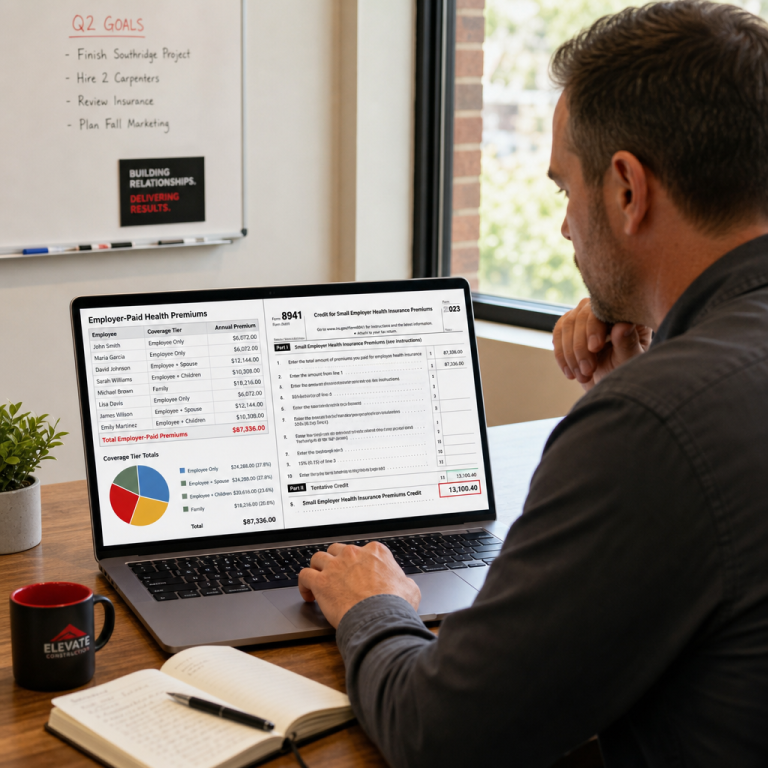
The small-business health care tax credit has its own tests. The IRS says eligible employers generally need fewer than 25 full-time equivalent employees, average wages below the applicable limit, and an employer contribution toward premiums. Review the IRS rules for the small-business health care tax credit before assuming your company qualifies.
This approach may be less flexible when your crew works across several states or needs a special network near remote sites. Check each hospital and urgent-care location before enrollment.
3. Predictable Premium Group Health Coverage
Traditional premium-based group coverage charges the employer a set premium for each enrolled worker or family unit. It’s best for a small contractor that values a known monthly bill over control of claim funds.

The carrier takes on the risk of covered claims. If one employee needs major care, the employer usually doesn’t pay that claim directly. The firm still pays its share of the premium, plus any agreed admin costs.
This structure makes budgeting easier. You can forecast the employer share, set payroll deductions, and plan for renewal changes. It also gives employees a familiar benefits format with a summary of deductibles, copays, and covered services.
Plans that follow Affordable Care Act rules must cover essential health benefits. These include hospital care, emergency care, prescription drugs, mental health care, maternity care, and preventive services. The exact design and network still vary by plan.
The trade-off is less control. A carrier may raise renewal rates after reviewing the group’s age mix, location, and claims profile. Construction policies can also face higher pricing because the sector has frequent injury claims. Ask the broker to show the renewal process in writing.
Premium-based group coverage often works well when you need stable cash flow and don’t want a claims reserve sitting on your books.
4. Level-Funded Plans, A Middle Ground for Stable Groups
Level-funded plans combine a fixed monthly payment with a claim fund and stop-loss protection. They’re best for a stable small group with enough enrollment data to support a more detailed review.
Part of the monthly payment may cover expected claims. Another part pays for administration and protection against very high claims. If claims run below the expected level, the contract may include a possible surplus credit. The contract controls how that works.
This can give an employer more rate detail than a traditional group plan. It may also produce a lower starting premium when the group’s risk profile is favorable. But the lower figure is not guaranteed, and it should never be judged by premium alone.
Ask about underwriting, stop-loss terms, exclusions, renewal rules, and what happens if an employee leaves midyear. A level-funded plan can also be a poor match for a very small or fast-changing crew because one new hire can change the group profile.
Construction owners should pay close attention to the network. A cheap plan does little good if a worker must drive hours to reach a participating facility after an injury.
Use this option when your group is steady and you’re willing to review the contract beyond the first-year rate.
5. Self-Funded Plans, More Control for Larger Small Businesses
Self-funded plans use employer money to pay covered claims instead of shifting every claim to an insurer. They’re best for a larger small business with strong cash reserves, steady enrollment, and help from a qualified administrator.
The employer pays claims from a dedicated fund. A third-party administrator may handle eligibility, claim processing, provider access, and member support. Stop-loss coverage can protect the firm from unusually large individual or group claims.
This structure can give the employer more control over plan design and claim data. It may also let the business see where costs rise, such as emergency care, prescription use, or repeated out-of-network treatment.
That control adds work and risk. The employer must fund claims on time. It must review compliance duties and understand the stop-loss contract. A claim surge after several site injuries can place pressure on cash flow.
Self-funding is usually a poor first move for a small contractor with only a few enrolled workers. A plan with more predictable costs or a level-funded plan may protect the budget better. If your company is growing, ask for a side-by-side risk review before changing structures.
This choice belongs on the table when the group is large enough to produce useful claims data, not simply because the first quote looks expensive.
6. Group Health Plans With Employee Cost Sharing
Some group health plans pair lower premiums with a higher deductible. They’re best for crews that can handle more upfront cost and want a way to prepare for eligible care expenses.
An employer may contribute a set amount toward eligible medical costs, match part of an employee’s contribution, or make no contribution. The choice affects how attractive the plan feels during enrollment.
For construction workers, the deductible deserves close attention. A worker who suffers an injury may face bills before the plan pays much of the cost. An employer can soften that risk with a contribution toward medical expenses or a supplemental benefit, but the plan documents must show the limits.
Compare the full year cost, not the monthly premium. Include the deductible, out-of-pocket maximum, employer contribution, prescription rules, and urgent-care access. A plan with a low premium can cost more after a serious event.
Prescription coverage needs a close look too. Ask how specialty drugs are handled and whether the plan uses a separate pharmacy deductible. If employees ask about high-cost weight-loss or GLP-1 drugs, request the carrier’s current coverage policy rather than making assumptions.
These plans can work well when the employer contribution is clear and employees understand how to use the available benefits.
7. Employer Contribution Strategies for Group Health Plans
Employer contribution strategies let a company fund approved health costs under set rules. They’re best for a company that wants to control its contribution while giving workers a choice among permitted coverage options.
A group plan with a defined contribution approach can help split the budget between the premium and other eligible expenses. Another design may support individual coverage instead of offering one group policy. The right arrangement depends on the plan design and current federal rules.
Contribution equity matters on a mixed construction crew. A flat amount gives each eligible worker the same dollar support. A percentage contribution changes the employer cost as the premium changes. A broker can model both methods against employee-only and family coverage.
Administrative detail is the catch. The employer must follow the plan’s notice, eligibility, documentation, and reimbursement rules. Payroll records must match the election and payment process. A casual promise to “help with insurance” is not a substitute for a written plan.
Contribution rules can change by design. Before enrollment, confirm what the arrangement covers, who can join, how unused funds are treated, and how the plan interacts with other coverage. Official small-business benefits guidance can help frame the discussion.
8. Health-Sharing Options, An Alternative Cost-Saving Path
Health-sharing programs ask members to share eligible medical costs under membership rules instead of using standard health insurance. They’re best for employers seeking an alternative price path and willing to explain the limits clearly.
The cost appeal can be strong. The research material cites possible savings of 30% to 70% compared with traditional medical insurance. Treat that as a marketing claim that needs a written quote and a careful review, not as a guaranteed result for your firm.
Health sharing is not the same as an ACA-compliant insurance policy. Membership rules may limit payment for certain conditions, treatments, or situations. There may also be no legal promise that every eligible bill will be paid. Employees need to understand that difference before they enroll.
Ask about pre-existing conditions, claim review, maternity rules, prescriptions, preventive care, and what happens after a worker leaves. If a worker needs care after a fall or heat emergency, the process should be clear before the event happens.
This option deserves review only when the employer and workers understand both the savings claim and the coverage limits.
9. Supplemental Benefit Bundles, Benefits Tradespeople Use
Supplemental benefits add lower-cost support around the main medical plan. They’re best for employers who want useful benefits without paying for a richer medical design than the budget allows.
Supplemental benefits may help with routine care or other approved expenses, subject to plan limits. The exact benefits vary, so compare the allowance and waiting rules instead of judging by the label.
Supplemental benefits deserve special attention in construction. A medical plan pays covered health costs under its terms. A supplemental policy may provide a separate cash benefit after a covered injury. It doesn’t replace health insurance, workers’ compensation, or employer liability coverage.
Ask how the benefits work together. A worker may have health insurance for hospital treatment, workers’ compensation for a work-related injury, and a supplemental benefit for a separate payment. The claims process should tell the employee which plan to use first.
These add-ons can also help part-time or lower-paid workers see value in the benefits package. But avoid loading the plan with extras that the crew won’t use. A short benefit survey can show whether routine-care benefits, supplemental cash, or disability support has the strongest pull.
For many small contractors, a sound medical plan plus targeted supplemental coverage beats a costly package full of unused features.
10. Telemedicine and High-Performance Network Plans, Access at Remote Job Sites
Telemedicine and high-performance networks focus on access, cost control, or both. They’re best for crews spread across job sites where a nearby clinic may be easier to use than a large hospital network.
Telemedicine can give employees a way to speak with a clinician without leaving a site for a minor concern. It may help with follow-up care, routine questions, or triage. It cannot replace emergency treatment after a serious injury.
Network distance is a major construction issue. Research supplied for this article identifies hospitals more than 90 kilometers from a work site as ineffective for many workers. That is why remote crews should ask about local reimbursement rules, not only the national network name.
High-performance networks may steer members toward selected doctors and facilities. The trade-off can be lower cost with less choice. Check the network in every town where your crews work, then confirm urgent care and emergency rules for travel.
Ask whether virtual care has a separate fee, whether it covers mental health visits, and what happens when a worker has poor cell service. Also ask how pharmacy access works near temporary sites.
The best network is the one employees can use during a normal week, not the one with the largest logo on the brochure.
Group Health Insurance Options Compared for Small Construction Companies
No single plan type wins for every contractor. The right choice depends on the size of the group, cash reserves, worker locations, and how much cost risk the owner can accept.
Small employers are generally not required to offer health insurance when they have fewer than 50 full-time employees. Still, coverage can support hiring and retention, especially when skilled workers can choose between several contractors.
Ask for the full annual employer cost. Include premiums, admin fees, expected contributions, deductible support, and any tax credit. A low monthly quote may look different after a worker uses emergency care.
What to Look for Before Requesting a Quote
Prepare the information a broker or carrier needs before requesting a quote. A clean census reduces back-and-forth and makes the comparison more useful.
- List each eligible worker’s status, hours, age band, work location, and family election.
- Separate employees from independent contractors and migrant labor.
- Set the employer contribution as a flat amount or a clear percentage.
- Mark every county or town where crews work.
- Ask for deductible, out-of-pocket maximum, prescription, and emergency details.
- Confirm cashless hospital access at the local block or county level.
- Ask how endorsements match payroll dates and new-hire periods.
- Request loading caps where the carrier permits negotiation.
Employer-certified rosters can help reduce adverse selection when the workforce changes often. Keep the roster current, then align enrollment updates with payroll. These small controls can protect coverage continuity and prevent a worker from being left off the plan.
Life Care Benefit Services can review these details with you and request quotes that fit the crew’s actual work pattern. Ask for a written comparison rather than a single headline premium.
Frequently Asked Questions
How many employees do I need for group health insurance?
You may qualify with as few as two eligible employees, but the exact rule depends on the state and carrier. Many small-group arrangements focus on full-time employees and exclude the owner’s spouse from the employee count. Part-time workers, contractors, and seasonal staff may follow different rules. Confirm eligibility before requesting a quote.
Is group health insurance required for a small construction company?
Most companies with fewer than 50 full-time employees aren’t required by federal law to offer health coverage. A company may still provide it to compete for skilled workers and retain crew leads. State rules and special employer structures can differ, so review the employer mandate with a licensed professional before making a decision.
How much does group health insurance cost for construction workers?
Construction group rates may run 15% to 40% above standard group rates because of claims risk and the work environment. Your actual cost depends on location, ages, family elections, plan design, and employer contribution. Compare total annual cost, not premium alone. A broker can show how deductibles and accident benefits change the budget.
Can a small contractor offer an HSA with health insurance?
Yes, a small contractor can offer an HSA-linked plan when the health plan meets the required eligibility rules. The employer may contribute to the account, but the amount and timing should be written into the benefit plan. Employees should understand the deductible, eligible expenses, account rules, and what happens when they leave.
Does group health insurance cover work injuries?
Group health insurance may cover medical care under its plan rules, but work-related injuries can also involve workers’ compensation. The plans have different purposes and claim processes. Construction employers should ask how an injury is reported, which coverage pays first, and whether accident or disability benefits can add support.
What should I ask about a health plan for remote job sites?
Ask about hospitals, urgent-care centers, emergency transport, reimbursement, and telemedicine near every job site. A broad national network may still be hard to use in a rural area. Confirm local access before enrollment. The research behind this article warns that facilities more than 90 kilometers away may not be effective for field workers.
Conclusion
For most small construction companies, start with an independent comparison of fully insured, level-funded, HDHP, and HRA options. Life Care Benefit Services can help match the plan to your roster, budget, and job-site locations. Gather your employee census and work-site list, then request a written quote comparison before open enrollment.





One Comment