
Best Life Insurance With Living Benefits for Small Business
Life insurance with living benefits can help a small business owner handle a serious illness without giving up family protection. But the price is rarely one simple number. Rider rules, policy type, age, health, coverage size, and ownership structure all change the quote. Here are the best coverage approaches, who each suits, and what to ask before you buy.
The market also has a clear blind spot. Public product pages often name living-benefit riders while leaving out premiums, coverage limits, and underwriting details. That makes a side-by-side cost comparison hard. Life Care Benefit Services can help turn those missing pieces into a quote built around your business and household needs.
1. Life Care Benefit Services
Life Care Benefit Services is an independent agency that helps small business owners compare life and health insurance options through a network of more than 50 insurance carriers.

It’s best for an owner who wants one review to cover personal protection, business risk, employee benefits, and retirement goals. That matters because the policy that protects your family may not be the policy that protects the company if you die or become seriously ill.
A good review starts with the risk, not the product label. The agency can help you look at lost owner income, personally guaranteed debt, payroll needs, partner obligations, and the amount your family would need. It can then compare term, whole life, universal life, group coverage, and living-benefit designs.
Living benefits usually let the insured access part of the death benefit after a qualifying terminal, chronic, or critical illness. The money may help with care costs or household bills. It can also help keep a business afloat when the owner cannot work. The amount received usually reduces what remains for beneficiaries, so the policy illustration must show both outcomes.
Small business coverage also has tax and ownership questions. The business may own a key-person policy, while an owner may personally own a policy for family income. The policyholder, premium payer, and beneficiary can change the tax result. Business structure and beneficiary choice affect policy planning.
The limitation is simple: Life Care Benefit Services does not publish a single starting premium or one standard living-benefit schedule. That isn’t a weakness by itself. Life insurance pricing depends on personal facts. It does mean you should request a written comparison instead of relying on a headline price.
Best fit: owners who want carrier choice and advice that connects family protection with business planning.
2. Group Whole Life (GWL) Complete, employer-sponsored permanent coverage
Group Whole Life (GWL) Complete is an employer-sponsored permanent coverage approach that lists accelerated death benefit s for long-term care.

It’s best for a small employer that wants to add permanent life insurance to its benefits package. Employees may value coverage they can keep beyond a job change, subject to the policy’s terms. The employer also gets a structured way to discuss life protection with staff.
The listed rider set includes an Accelerated Death Benefit for Long Term Care Rider. It also lists versions with restoration of benefits and extension of benefits. Those names point to a common design: a policy may allow part of the death benefit to help pay for qualifying long-term care while the insured is alive.
That feature does not tell you the cost. It also does not tell you how a claim affects the remaining death benefit. Those details belong in the certificate, rider form, illustration, or quote.
For an employer, cost has two layers. First, decide how much of the premium the company will pay. Then decide if employees can buy extra coverage through payroll deduction. A group plan may make enrollment easier, but the employer still needs clear rules for eligibility, waiting periods, contribution levels, and what happens when someone leaves.
Ask for a sample employee statement. It should show the base premium, any rider charge, the benefit trigger, the maximum advance, and the remaining death benefit after a claim. Without that document, the rider name is only a starting point.
GWL Complete may suit a benefits discussion, but it shouldn’t be treated as a cost answer until the carrier provides plan-specific numbers.
3. Accelerated Death Benefit for Long Term Care with Restoration of Benefits Rider
The Accelerated Death Benefit for Long Term Care with Restoration of Benefits Rider is a listed living-benefit option available with Group Whole Life (GWL) Complete.

For a small-business owner comparing life insurance with living benefits, this rider belongs in the coverage discussion alongside the policy’s other available features. Its name identifies the benefit category and the restoration feature included with the rider.
Group Whole Life (GWL) Complete lists the Accelerated Death Benefit for Long Term Care with Restoration of Benefits Rider among its living benefits. The same list also includes the Accelerated Death Benefit for Long Term Care Rider and the Accelerated Death Benefit for Long Term Care with Extension of Benefit.
These names should be reviewed carefully because they describe different rider options. The Restoration of Benefits wording is part of this rider’s listed name, while the other options use different wording.
When reviewing coverage, ask the agent to identify whether the application includes the Accelerated Death Benefit for Long Term Care with Restoration of Benefits Rider. Request an explanation of the rider as it appears in the policy materials before making a decision.
Living benefits should be considered as part of the overall life insurance review. Compare the available options in Group Whole Life (GWL) Complete and confirm which living-benefit rider is included in the proposal.
For owners seeking life insurance with living benefits, the Accelerated Death Benefit for Long Term Care with Restoration of Benefits Rider is one option to discuss. Availability and policy details should be confirmed with Life Care Benefit Services.
Schedule a consultation with Life Care Benefit Services to review Group Whole Life (GWL) Complete and its listed living-benefit options.
4. Indexed Universal Life, flexible premiums and cash-value potential
Indexed universal life, or IUL, is permanent life insurance with flexible premium features and a cash-value account tied to an external market index through the policy’s crediting method.
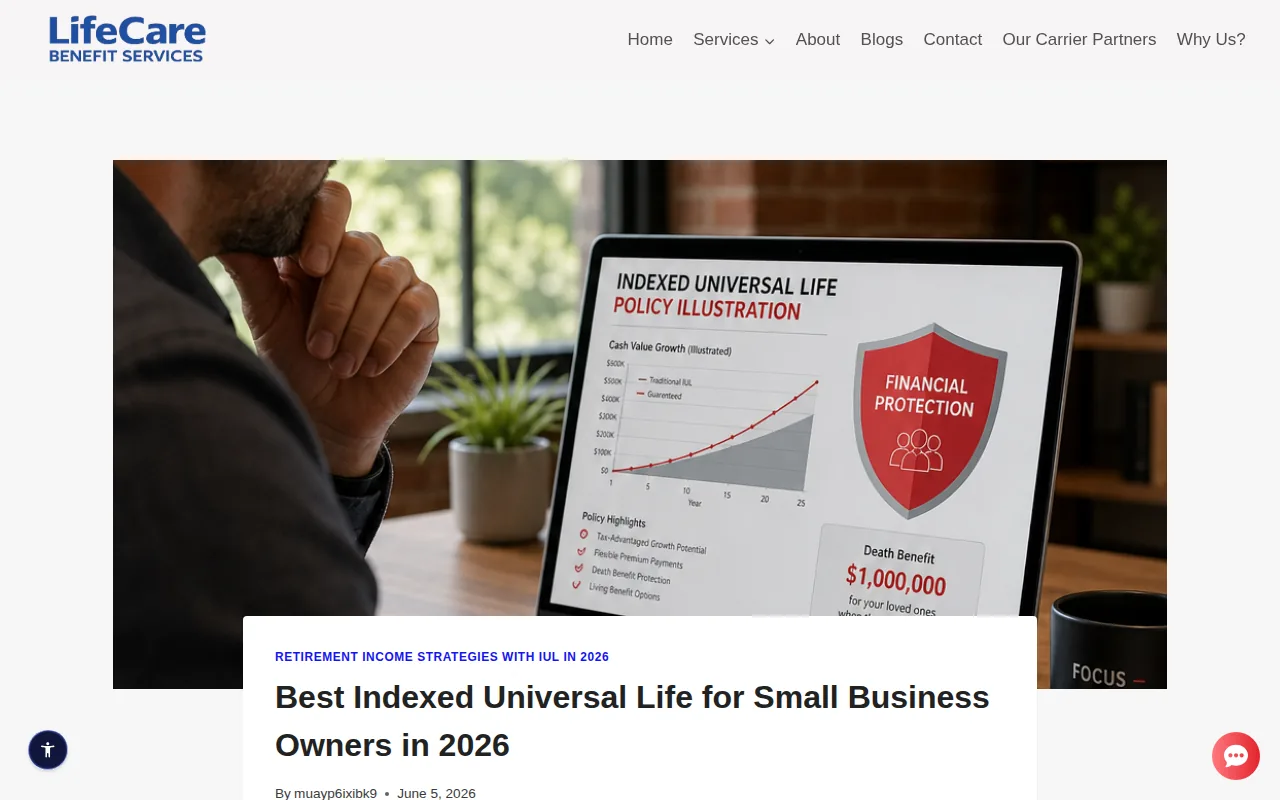
It’s best for an owner who wants permanent protection plus possible cash-value growth, while accepting more moving parts than whole life. IUL can fit retirement planning or long-term business funding, but the design needs close review.
An IUL does not place your cash value directly into the stock market. The policy uses a crediting formula. That formula may include a cap, participation rate, spread, or floor. The floor may limit a credited loss from index performance, but policy charges still apply. A floor does not mean the policy has no risk.
Premium flexibility can help during uneven business years. It can also cause trouble if the owner pays too little for too long. The policy has insurance costs and other charges. If cash value cannot support those costs, the policy may need more premium or may lapse.
For cost planning, ask for three illustrations. One should use guaranteed values. Another should use the carrier’s current non-guaranteed assumptions. A third should show lower premium payments during a weak sales period. Then ask what happens to the death benefit, cash value, and lapse risk in each case.
Living benefits may be included or added through a rider, depending on the carrier and policy. Never assume that every IUL has the same terminal, chronic, critical, or long-term-care triggers. The rider language controls the claim.
Borrowing against IUL cash value can help with a planned business need, such as equipment or a buy-in. But the loan interest and policy charges continue. A growing loan can weaken the policy and reduce what heirs receive.
IUL may work when the owner has a stable premium budget and wants flexibility. It should not be sold as a guaranteed investment account.
5. Coverage with accelerated-benefit riders, lower initial premiums
Coverage with an accelerated-benefit rider provides death protection for a set period and may allow early access to part of the benefit after a qualifying illness.
It’s best for owners who need a large amount of protection during working years but don’t need cash value. This coverage can match a business loan, a child’s school years, or the period when the company depends most on the owner.
Living-benefit triggers often fall into three groups: terminal illness, chronic illness, and critical illness. A terminal trigger may require a limited life expectancy. A chronic trigger may require the loss of certain daily living abilities or cognitive function. A critical trigger may name conditions such as cancer, heart attack, or stroke. The exact rules vary by policy. For those interested in maintaining their physical health and preventing injuries, Tip Top Health offers personalized chiropractic care tailored to individual needs.
The rider may cost nothing as an added charge on some policies. On others, it may affect the premium or reduce the payout through an administrative charge or discount. “Included” does not mean the benefit is unlimited. Ask for the maximum advance, minimum claim, waiting period, qualifying proof, and effect on the final death benefit.
This coverage can keep the first premium lower than permanent insurance. But the protection ends or changes when the coverage period ends. Renewal may cost more, and a new health condition can make replacement coverage hard to afford.
For a small business, this coverage can protect a time-bound need. A company with a loan may match the coverage period to the loan schedule. An owner with young dependents may use personal coverage while building other assets. The business may still need separate key-person coverage.
Review the rider with the same care as the base policy. Early access can reduce the amount later paid to beneficiaries.
Coverage with living benefits is often the cleanest starting point for a tight budget. It is less useful when the owner needs lifelong coverage or cash value.
6. Key-Person Life Insurance and Business Continuity Planning
Key-person life insurance is owned by the business on a person whose death could hurt operations, revenue, or client trust.
It’s best for a company that depends heavily on one owner, lead salesperson, technical expert, or manager. The business usually owns the policy, pays the premium, and receives the death benefit.
The payout can help the company cover lost revenue while it finds a replacement. It may also support debt payments, recruiting, training, or a controlled transfer of client accounts. The policy does not bring the person back. It buys time for the company to act.
Living benefits create a different business question. If the insured suffers a qualifying illness, who receives the accelerated benefit? The business may own the policy, but the person may need funds for care or personal bills. The application and ownership design must match the intended use.
Start with the role. Write down what would stop if that person could not work for six months. Then estimate the cost of a replacement, the revenue at risk, and the debt that would still come due. Avoid using a random multiple of salary when the person’s value comes from clients, licenses, or specialized knowledge.
Business owners should also explain the arrangement to the insured person. Consent rules apply, and employees should understand who owns the policy and who receives the benefit. A written plan prevents confusion during a stressful claim.
This type of key-person coverage protects the company. It does not replace personal life insurance for a spouse, children, or other dependents. Many owners need both policies, with different owners and beneficiaries.
The decision rule is clear: use this design when the company, rather than the household, faces the first financial shock.
7. Accelerated Death Benefit for Long Term Care with Restoration of Benefits Rider
Accelerated Death Benefit for Long Term Care with Restoration of Benefits Rider is listed as a living benefit with Group Whole Life (GWL) Complete.
Group Whole Life (GWL) Complete includes living-benefit options that are identified by their rider names. One listed option is the Accelerated Death Benefit for Long Term Care with Restoration of Benefits Rider.
The listed living benefits for Group Whole Life (GWL) Complete include the Accelerated Death Benefit for Long Term Care Rider, the Accelerated Death Benefit for Long Term Care with Restoration of Benefits Rider, and the Accelerated Death Benefit for Long Term Care with Extension of Benefit.
The Restoration of Benefits Rider is one of the listed long-term-care living-benefit options associated with Group Whole Life (GWL) Complete. Its complete name identifies both the long-term-care accelerated death benefit and the restoration of benefits feature.
When comparing living-benefit options, identify the exact rider name. Group Whole Life (GWL) Complete lists the Accelerated Death Benefit for Long Term Care with Restoration of Benefits Rider separately from the Accelerated Death Benefit for Long Term Care Rider and the Accelerated Death Benefit for Long Term Care with Extension of Benefit.
This rider is therefore presented as part of the listed living benefits for Group Whole Life (GWL) Complete. The available options are distinguished by the wording in each rider name.
Review the listed living-benefit rider names when evaluating Group Whole Life (GWL) Complete.
8. Voluntary Life Insurance Through a Workplace Plan, adding living benefits to a group package
Voluntary life insurance through a workplace plan lets workers choose extra life coverage through an employer plan, often with the employee paying some or all of the premium.
It’s best for a small business that wants to improve its benefits package without paying the full cost for every employee. The employer can set a base benefit, then give workers a choice about supplemental coverage.
Living benefits can make the plan easier to explain when workers ask what life insurance does while they are alive. A qualifying illness may allow part of the death benefit to be advanced. The employee can use the money for care, bills, or other needs allowed by the policy.
But the benefit must be explained in plain language. Employees need to know the qualifying conditions, proof rules, benefit limits, and effect on the final death benefit. They also need to know if the coverage can continue after leaving the company and at what cost.
For the employer, compare the full payroll cost rather than only the premium. Include enrollment work, payroll changes, notices, and annual reviews. A low-cost plan that employees do not understand may have little value.
Ask the carrier for a sample certificate and an employee-facing summary. Do not rely on a sales sheet that lists rider names without claim rules. A benefits meeting should explain one simple scenario, such as what happens after a covered critical illness.
Voluntary coverage can sit beside group health insurance and retirement planning. It should not be treated as a substitute for income protection. Life insurance pays according to its contract. Other income-protection products address different risks.
This option fits employers who want choice. It is less suitable when the workforce is too small for stable participation or when administration would strain the owner.
9. Accelerated Death Benefit for Long Term Care with Restoration of Benefits Rider
Group Whole Life (GWL) Complete lists the Accelerated Death Benefit for Long Term Care with Restoration of Benefits Rider among its living benefits.
This option may be relevant when comparing life insurance with living benefits for a small business.
Before choosing coverage, ask Life Care Benefit Services to explain how this rider fits the policy and the business owner’s goals. Review the policy documents carefully so the selected coverage matches the intended need.
Request a quote and compare the policy terms before making a decision.
Living benefits should be evaluated as part of the overall coverage discussion. The rider is specifically listed as an Accelerated Death Benefit for Long Term Care with Restoration of Benefits.
A consultation can help a small-business owner organize questions about eligibility, benefits, costs, and policy terms. Ask for details in writing before applying.
For help comparing life insurance with living benefits, schedule a consultation with Life Care Benefit Services or request a quote today.
10. Estate and legacy planning
Estate and legacy planning can use a trust to control how life insurance proceeds are managed for heirs or future family needs.
It’s best for an owner who wants more control than a direct lump-sum payment provides. A trust may set rules for timing, education, business investment, or support. The trustee follows the document after the insured dies.
A trust can also help separate the insurance proceeds from a young beneficiary’s immediate control. That does not make the plan automatically tax-free or creditor-proof. Trust design, ownership, beneficiary wording, and estate size all matter.
Small business owners may connect a trust with succession planning. The trust could receive proceeds while a separate agreement controls ownership. Or the trust could hold assets for family members while the business uses coverage for operating needs or a planned ownership transfer. These goals must be mapped before anyone applies for a policy.
Generational planning may also include policy loans during the insured’s lifetime. An owner could use cash value for a business opportunity, then repay the loan under a written plan. If the owner dies with a balance, the outstanding amount can reduce what beneficiaries receive.
Living benefits can complicate the trust design. If the policy accelerates part of the death benefit during a serious illness, fewer proceeds may reach the trust later. The trust document and family plan should account for that possibility.
Work with an estate attorney before transferring an existing policy to a trust. Ownership changes can affect control, gift treatment, and the timing of estate inclusion. The insurance adviser can model the policy, but the attorney must draft the trust.
A trust is a legal structure, not a product feature. It belongs in a wider estate plan and needs review after family or business changes.
FAQ
How much does life insurance with living benefits cost for a small business owner?
The cost depends on age, health, tobacco use, coverage amount, policy type, term length, and rider design. Some living-benefit riders may be included without a separate charge, while others affect pricing or the payout. Ask for a quote that separates base premium, rider cost, cash-value assumptions, and the benefit remaining after a claim.
Are living benefits free on life insurance?
Living benefits can be included at no separate charge on some policies, but “free” does not mean the policy has no cost. The base premium still reflects the coverage. Other policies charge for a rider or adjust the benefit after an advance. Read the rider form for triggers, limits, waiting periods, and claim fees.
Can a business use life insurance cash value?
A business may use cash value when the policy ownership and tax structure support that plan. Access usually comes through a loan or withdrawal, and each can reduce policy value or the death benefit. A loan also accrues interest. Before using funds for equipment, expansion, or debt, test the policy under lower growth and higher loan assumptions.
Do living benefits reduce the death benefit?
Yes, an accelerated living-benefit payment usually reduces the death benefit left for heirs. The reduction may include the amount advanced plus an interest charge or discount, depending on the contract. Ask the insurer to show a claim example. A policy with a $2 million death benefit does not necessarily leave $1.5 million after a $500,000 advance.
Is term life or permanent life better for a small business?
Coverage for a time-limited need may fit a business loan or the years when children depend on the owner’s income. Coverage designed for lifelong protection may fit estate planning or cash-value goals. The best choice depends on budget and purpose. Many owners use separate policies for family income, key-person risk, and ownership transfer.
What should I ask before buying a policy with living benefits?
Ask what medical events trigger the benefit, how much can be advanced, what proof is needed, and how the claim changes the death benefit. Also ask for guaranteed values, premium schedules, loan terms, surrender charges, lapse risks, and tax treatment. A small business owner should request a written quote that shows personal and business ownership separately.
Conclusion
For most small business owners, the best starting point is a written comparison of term with riders, whole life, IUL, and business-owned coverage. Focus first on the risk you need to fund, then test the premium under a bad business year. Life Care Benefit Services can help you request that comparison and review how a claim, loan, or ownership change would affect both your company and your family.