
Indexed Universal Life for Single Parents: A Guide
As a single parent, you’re the only financial safety net your children have. One policy can cover that responsibility and build wealth at the same time. This guide walks you through exactly how to set up indexed universal life insurance so it actually works for your situation.
Step 1: Understand How Indexed Universal Life Insurance Works
An indexed universal life (IUL) policy is permanent life insurance with two parts: a death benefit that pays your family when you’re gone, and a cash value account that grows while you’re alive. You pay a premium each month. Part of that covers the cost of insurance. The rest goes into the cash value.
What makes IUL different from standard universal life is how the cash value grows. It’s linked to a market index like the S&P 500, but your money isn’t actually invested in stocks. The insurer watches the index and credits interest to your account based on how the index performs.
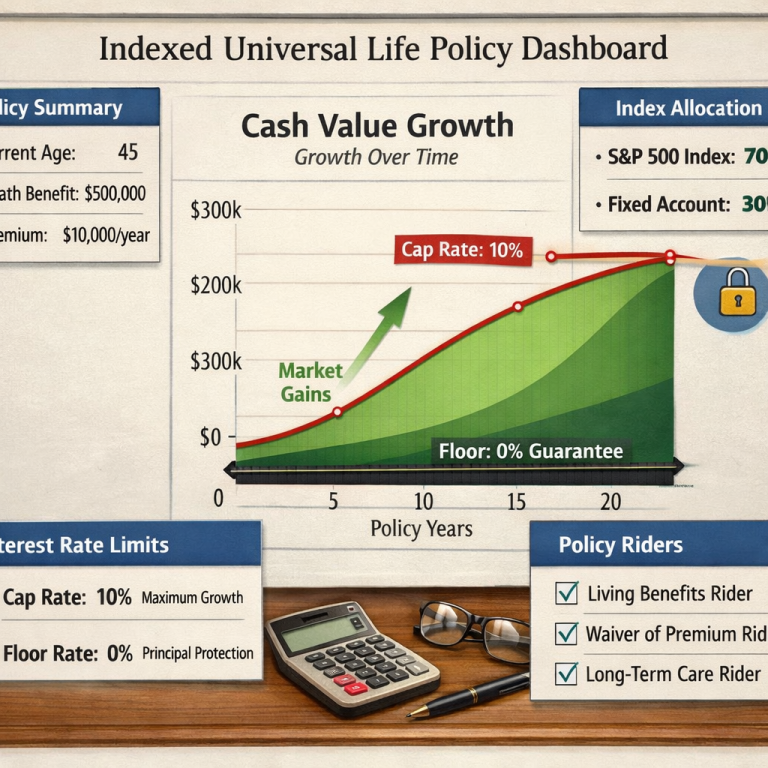
Two guardrails control that growth. A floor(usually 0%) means the index can drop 20% and your cash value stays flat rather than losing ground. A cap limits how much you gain in a good year. If the cap is 10% and the index rises 18%, you get 10%. You give up some upside in exchange for that downside protection.

of universal life insurance, the cash value in a universal life policy grows tax-deferred, and the death benefit is paid income-tax-free to beneficiaries. Both advantages carry over to IUL.
There’s one number to watch carefully. In a review of 28 IUL policy features across four finance sites, 61% of policies listed caps under 13%, and a single outlier inflated the dataset’s average to an absurd figure. If you see an average cap quoted somewhere that looks unusually high, that number is almost certainly distorted by one extreme case. Focus on the specific cap in any policy you’re actually considering, not industry averages.
By the end of this step, you should be able to explain the floor, the cap, and the participation rate to someone else. Those three terms are the engine of every IUL policy you’ll encounter.
Step 2: Assess Why IUL Makes Sense for Single Parents
Single parents face a specific financial reality: one income, dependents who rely entirely on that income, and no partner to absorb a financial shock. A term policy covers the death benefit but expires. Whole life covers you permanently but costs more and offers less flexibility. IUL sits in between.
The flexible premium is the feature that matters most here. If you have a lean month , a car repair, a medical bill, an unexpected childcare cost , you can lower your IUL premium within the policy’s allowed range. Most other permanent policies don’t give you that option. You either pay or risk lapsing.
The cash value adds a second layer of security. Once it has accumulated enough, you can borrow against it tax-free for an emergency without touching a savings account or going into credit card debt. That loan doesn’t show up on a credit check and doesn’t require approval. For a single parent juggling a tight budget, that kind of quiet liquidity matters.
IUL also works as a long-term retirement supplement. Because the cash value grows tax-deferred and you can take loans against it tax-free later, it functions as an additional savings bucket outside your 401(k) or IRA. That’s especially useful if you’ve maxed your retirement contributions or don’t have access to an employer match. Many single parents who own renters or homeowners insurance are already managing multiple financial products , adding an IUL ties protection and growth into one policy. If you’re also thinking about how your property coverage stacks up, resources like working with an independent insurance agent near you can help you see the full picture across all your policies.
Step 3: Calculate How Much Coverage You Actually Need
The death benefit is the number your children depend on if you’re gone. Getting it right matters more than almost any other decision in this process.
Start with income replacement. A common rule is 7 to 10 times your annual income. For single parents, raw income replacement may not be enough. Add what it would cost to replace the unpaid work you do: childcare, transportation, household management. Those costs are real, and they fall on someone else if you’re not there.
Then add specific obligations. Remaining mortgage or rent. Years of school tuition. Any debts a co-signer would inherit. Subtract any savings or existing coverage you already have.
One thing many sources skip: only 21% of the policy feature sources reviewed in our research flagged common mistakes that erode coverage for single-parent households. The most frequent is underestimating childcare costs because they feel abstract. Run an actual number , call a local daycare or look up after-school program rates in your zip code , and put that figure in the table. For additional support in managing health alongside financial planning, single parents might find the NextBreath app a valuable resource.
For a deeper look at how to size a policy around your household specifically, the step-by-step breakdown in the Indexed Universal Life Insurance for Single Parents guide from Life Care Benefit Services walks through coverage calculations in plain terms.
Step 4: Compare IUL Policy Features That Matter Most

Not every IUL policy is built the same way. The differences show up in four places: the cap rate, the floor, the participation rate, and the cost of insurance (COI).
The cap rate is the ceiling on your annual cash value growth. Higher is better, but caps vary widely. In 39% of the policies reviewed in our research, the range wasn’t disclosed at all, which makes side-by-side comparison nearly impossible. Ask for this number in writing from any carrier you’re evaluating.
The participation rate controls how much of the index’s gain you actually receive. A 100% participation rate means you get the full index gain up to the cap. An 80% rate means you get 80 cents of every dollar the index earns. Some carriers use participation rates instead of caps, some use both. Know which mechanism your policy uses.
The COI is the cost the insurer deducts to maintain your death benefit. It rises as you age. If you pay only the minimum premium, more of your payment goes to COI over time and less builds cash value. Single parents who expect to keep a policy for decades should model out the COI trajectory in the policy illustration, not just look at year-one numbers.
Riders also matter. A living benefits rider lets you access part of the death benefit early if you’re diagnosed with a critical or terminal illness. For a single parent, that can prevent a medical crisis from wiping out savings before you’re gone. A waiver of premium rider suspends your payments if you become disabled. These add cost, but the protection they offer can be significant.
Step 5: Use the Cash Value Component Strategically
Cash value isn’t a savings account, but it behaves like one in several useful ways. The key is knowing when and how to use it without damaging the policy.
Policy loans are the most common access method. You borrow against the cash value rather than withdrawing from it. The policy stays in force. The loan isn’t reported to credit bureaus. Interest accrues inside the policy, and you can repay on your own schedule. If the policy stays active until you die, an unpaid loan simply reduces the death benefit , but the policy doesn’t lapse because of the loan itself.
Withdrawals work differently. You can pull out money up to the amount you’ve paid in premiums (your basis) tax-free. Anything above that is treated as income and taxed. Withdrawals also permanently reduce the cash value and the death benefit, so they’re less reversible than loans.
For single parents, the most strategic use of cash value is as a bridge fund. Let’s say your child needs braces, your car breaks down, and your emergency fund runs short , all in the same month. A policy loan covers the gap without triggering a tax event or hitting your retirement savings. You pay it back when your cash flow recovers.
The longer-term play is using cash value as a retirement supplement after your children are grown. Because loans come out tax-free, they don’t push you into a higher bracket the way traditional IRA withdrawals can. That’s a meaningful advantage if you expect your income to be higher in retirement than it is now.
One real caution: if your cash value drops too low because of loans, fees, and a flat crediting period hitting at the same time, the policy can lapse. A lapse triggers a taxable event on any gain. Review the cash value balance at least once a year, and talk to your agent if it starts trending in the wrong direction.
Step 6: Work With an Independent Agent to Get the Right Policy
IUL policies are complex enough that the agent you work with has a direct effect on the outcome. A captive agent represents one carrier. An independent agent can shop across dozens.
Life Care Benefit Services is an independent agency that works with more than 50 top-rated carriers. That matters for single parents because different carriers price the same coverage differently depending on your age, health, and how much death benefit you need. An agent who’s tied to one company can only offer you what that company has. Life Care Benefit Services can run illustrations from multiple carriers side by side so you’re comparing apples to apples.
When you meet with an agent, bring three things: a recent pay stub, a rough list of monthly expenses, and a number for how many years your youngest child needs financial support. Those three inputs shape the right face amount, premium structure, and rider selection.
Ask the agent to show you two illustrations for each policy: one at the current cap rate and one at a reduced rate. Indexed accounts credit interest based in part on the performance of major stock market indexes, and cash value is protected from market-based losses but reduced by policy charges and any loans or withdrawals. Any honest illustration should reflect both the growth potential and those deductions clearly.
Once you have two or three illustrations from different carriers, compare the cash value at year 10, year 20, and year 30. Look at the COI trend. Check whether the living benefits rider costs are included or quoted separately. Then ask what happens to the policy if you miss two premium payments in a row. The answer to that last question tells you a lot about how forgiving the policy design is under real-life pressure.
Life Care Benefit Services offers personalized consultations to walk through exactly this process. Schedule one before you commit to any policy, not after.
FAQ
Is IUL a good idea for single parents on a tight budget?
Yes, if you can commit to the minimum premium consistently. IUL’s flexible premium structure lets you reduce payments during hard months, which is one of its main advantages over whole life. The key is starting with a premium you can cover even in a lean year, not the maximum you can afford in a good month. Build in some breathing room from day one.
How long does it take for cash value to build up in an IUL policy?
Meaningful cash value typically takes five to ten years to accumulate because early premiums go heavily toward the cost of insurance and policy fees. The policy illustration will show you projected cash value at each year. Most single parents see cash value become genuinely usable as a borrowing source somewhere in years seven through twelve, depending on the premium amount and the index performance during that period.
What happens to my IUL policy if I lose my job?
You can reduce your premium to the minimum required amount to keep the policy active. If your cash value is large enough, the policy can sometimes self-sustain for a period using accumulated value to cover the cost of insurance. Talk to your agent before missing a payment , most carriers have options that aren’t obvious from the policy documents alone, and acting early prevents a lapse.
Can I name my minor child as the beneficiary?
You can, but there’s a catch. Minor children can’t legally receive a life insurance payout directly. If you name a minor child as beneficiary and you die before they turn 18, a court appoints a guardian to manage the funds , and that process can be slow and costly. A better option is naming a trusted adult as beneficiary with instructions in a will, or setting up a trust to receive the payout on the child’s behalf.
How does an IUL differ from term life insurance for a single parent?
Term life is temporary and costs less per dollar of coverage. It pays a death benefit but builds no cash value and expires after 10 to 30 years. IUL is permanent , it stays in force as long as you keep premiums current , and builds cash value you can access while alive. Single parents often use term for maximum coverage when children are young, then add or shift to IUL as income grows and cash value becomes a priority.
What should I watch out for when comparing IUL policies?
Focus on the cap rate, participation rate, and COI schedule , not just the projected cash value in year one. In a review of 28 policy features, 39% of policies omitted specific numeric ranges entirely, which makes real comparison difficult. Ask every carrier to disclose these figures in writing. Also check whether living benefits riders are included or cost extra, and model how the policy performs if the index credits 4% annually instead of the current cap.
Conclusion
Indexed universal life insurance can give single parents something rare: permanent protection that flexes when life gets hard, and a cash value that grows quietly in the background for decades. The most important next step is getting a real illustration, not a ballpark. Reach out to Life Care Benefit Services to request a personalized IUL illustration across multiple carriers , it’s the fastest way to see what the numbers actually look like for your household.