

Indexed Universal Life Benefits for Families: A Step‑by‑Step Guide 2026
Indexed universal life (IUL) can feel like a secret tool for families. It mixes life cover with cash growth. It can also give you money while you’re alive. This guide shows you how to use indexed universal life benefits for families step by step.
We’ll walk through five steps. You’ll learn how to size up protection, how the policy works, which living benefits fit, how to pick riders, and how to keep the plan on track. By the end you’ll know how to protect your family, grow cash, and avoid common traps.
An examination of 23 indexed universal life (IUL) benefits across 5 sources reveals that only a fifth actually tout a tax advantage, and most listed benefits lack any living‑benefit component.
Step 1: Assess Your Family’s Financial Protection Needs
First, you need to know how much money your family would need if you weren’t there. Think about mortgage, school costs, daily bills, and future plans. Write the numbers down. A simple spreadsheet works.
Next, ask yourself how long you expect to be the main earner. If you plan to work 30 more years, you’ll need a larger death benefit than if you’re close to retirement. Use theTitan Wealth International guideto see how IUL can fit long‑term plans.
Now look at your current insurance. Do you have term life? How much does it cost? Compare that cost to an IUL premium estimate. Remember, IUL premiums can change over time, but they also let you add cash value.
Here are three practical tips to size up protection:
- Calculate a “needs” amount:Add up all debts, future education costs, and a few years of living expenses. Multiply by a safety factor of 1.2 to cover inflation.
- Consider a “buffer” for unexpected events:Add $50,000‑$100,000 for emergencies like medical crises.
- Check your cash flow:Make sure the premium you choose fits your budget without squeezing other goals.
Imagine a family of four where the primary earner makes $120,000 a year. Their mortgage is $250,000, and they plan to fund two college educations costing $150,000 each. A quick calculation shows a need of roughly $700,000. Adding a 20% buffer brings it to $840,000. That number becomes a starting point for the IUL death benefit.
Don’t forget the tax side. Only 21% of the benefits we studied list a tax advantage. That means you should verify if the policy you pick truly offers tax‑free death benefits or tax‑deferred cash growth. TheGuardian Life pageexplains how tax treatment works for IULs.
Finally, talk to a licensed advisor. They can run a personalized illustration and show how the numbers look over 20, 30, or 40 years. A clear picture helps you avoid over‑paying for coverage you don’t need.
Step 2: Understand How Indexed Universal Life Policies Work
Now that you know how much you need, let’s see what the policy does. An IUL has two parts: a death benefit and a cash‑value account. The cash part grows based on a market index, like the S&P 500, but you never lose money because of the floor.
When you pay a premium, the insurer first takes the cost of insurance (COI) and fees. Anything left goes into the cash‑value bucket. That money can earn interest tied to the index. The insurer sets a cap , say 10% , and a floor , often 0% , so you only get credit up to the cap, and you never go below zero.
Here’s a step‑by‑step of a typical first year:
- Pay $300 monthly premium.
- Insurer deducts $120 for COI and fees.
- $180 goes into cash value.
- If the index climbs 12% and the cap is 10%, your cash value earns 10%.
- At year‑end, cash value grows to $1,980 (plus any prior balance).
That growth is tax‑deferred. You don’t pay tax each year, only when you withdraw or the policy ends. If you take a policy loan, the money is usually tax‑free as long as the policy stays in force.
One key point: the cash value can later cover the COI if the policy’s earnings are enough. That can let you skip premium payments for a while , a handy feature for families with fluctuating income.
To see more detail, read theNerdWallet explanation. It breaks down the crediting methods and shows how caps and floors work.
Another resource isEthos’s guide. It talks about the flexibility and the need for ongoing monitoring.
Why does this matter for families? Because the cash value can become a safety net. If you need money for a college tuition payment, you can borrow against the cash value. The loan is tax‑free, but you do pay interest back into the policy.
Pros and cons list:
- Pros:Tax‑deferred growth, flexible premiums, potential for higher returns than whole life, floor protects against loss.
- Cons:Caps limit upside, fees can eat returns, need to monitor crediting rates, policy can lapse if cash value falls.
Real‑world example: Jane, a 35‑year‑old teacher, bought a $500,000 IUL with a 6% participation rate and an 8% cap. After 10 years, her cash value reached $80,000. She used a loan of $30,000 to help pay for her son’s college. The loan was tax‑free and she repaid it over five years, keeping the death benefit intact.

Remember, the policy’s performance depends on the insurer’s crediting method and the caps they set. Review the illustration each year to see if the cash value is on track.
Step 3: Identify Living Benefits That Fit Your Family’s Goals
Living benefits are the parts of an IUL that let you use money while you’re alive. They come in three main forms: policy loans, withdrawals, and accelerated death‑benefit riders.
Policy loans let you borrow against cash value. You pay interest, but the loan doesn’t count as taxable income. Withdrawals let you take cash up to your basis (the amount you’ve paid in) tax‑free. Accelerated death‑benefit riders pay out a portion of the death benefit if you get a serious illness.
Here’s how to decide which one fits:
- Need cash for a short‑term crisis?A loan works well. You keep the death benefit, but you must repay the loan with interest.
- Planning for retirement income?Withdrawals up to basis can supplement Social Security without tax.
- Worried about health issues?An accelerated death‑benefit rider can give you a lump sum if you’re diagnosed with a critical illness.
Only two benefits in the research table actually list a living‑benefit component: “Living benefit , policy loans/withdrawals” (lifeinsure.com) and “Riders and Customization” (westernsouthern.com). That means many policies may not include these features unless you add riders. For more detailed guidance on evaluating related logistics and planning, consider كيفية حساب كميات الحفر والردم للموقع خطوة بخطوة بدقة هندسية.
Let’s look at a case study. The Smith family bought an IUL with a $600,000 death benefit and added an accelerated death‑benefit rider. When the father was diagnosed with a heart condition, the rider paid $80,000 tax‑free. The family used that money to cover medical bills and avoid dipping into savings.
When you shop for riders, watch the extra cost. Most riders add $10‑$20 per month. Compare that to the benefit you get. If you’re young and healthy, you might skip the rider now and add it later, but adding early locks in lower cost.
For more on rider options, seeNationwide’s IUL overview. It explains how riders work and what triggers payouts.
Another good read isOgletree Financial’s rider guide. It walks through which riders families typically need.
Below is a short video that shows how a policy loan works in practice.
Don’t forget the internal link that shows how to actually file a claim for a living benefit.How to Access Living Benefits on Indexed Universal Life Insurance …walks you through the paperwork and trigger events.
Step 4: Compare IUL Options and Choose the Right Rider
Now you have a list of features. Time to compare carriers and riders. The research shows that caps, participation rates, and fees differ a lot between companies.
Key things to look at:
- Cap rate:Higher caps let you capture more market upside. Look for caps 10%‑12%.
- Participation rate:100% means you get the full index gain up to the cap.
- Fees and COI:Lower fees mean more money stays in cash value.
- Rider availability:Check if the carrier offers accelerated death‑benefit, long‑term‑care, or over‑loan protection riders.
One helpful comparison comes fromAmplify’s best IUL list. It ranks carriers like Amplify, Fidelity & Guaranty, and Pacific Life based on features, caps, and rider options.
Another source,Ogletree’s company guide, looks at financial strength, cap consistency, and how carriers treat policyholders during market stress.
Here’s a quick checklist you can use when you talk to an agent:
- Ask for the current cap and participation rate for the index you like.
- Request a cost‑of‑insurance (COI) schedule for your age.
- Find out the exact cost of any rider you want.
- Check the insurer’s A.M. Best rating , A or higher is solid.
- Ask how often the insurer reviews caps , annual caps can change.
Example: A family in Ohio looked at two carriers. Carrier A offered a 9% cap, 100% participation, and a $15/month accelerated death‑benefit rider. Carrier B offered an 8% cap, 80% participation, but lower COI charges. After running numbers, the family chose Carrier A because the higher cap gave them $12,000 extra cash value after ten years, which outweighed the extra rider cost.
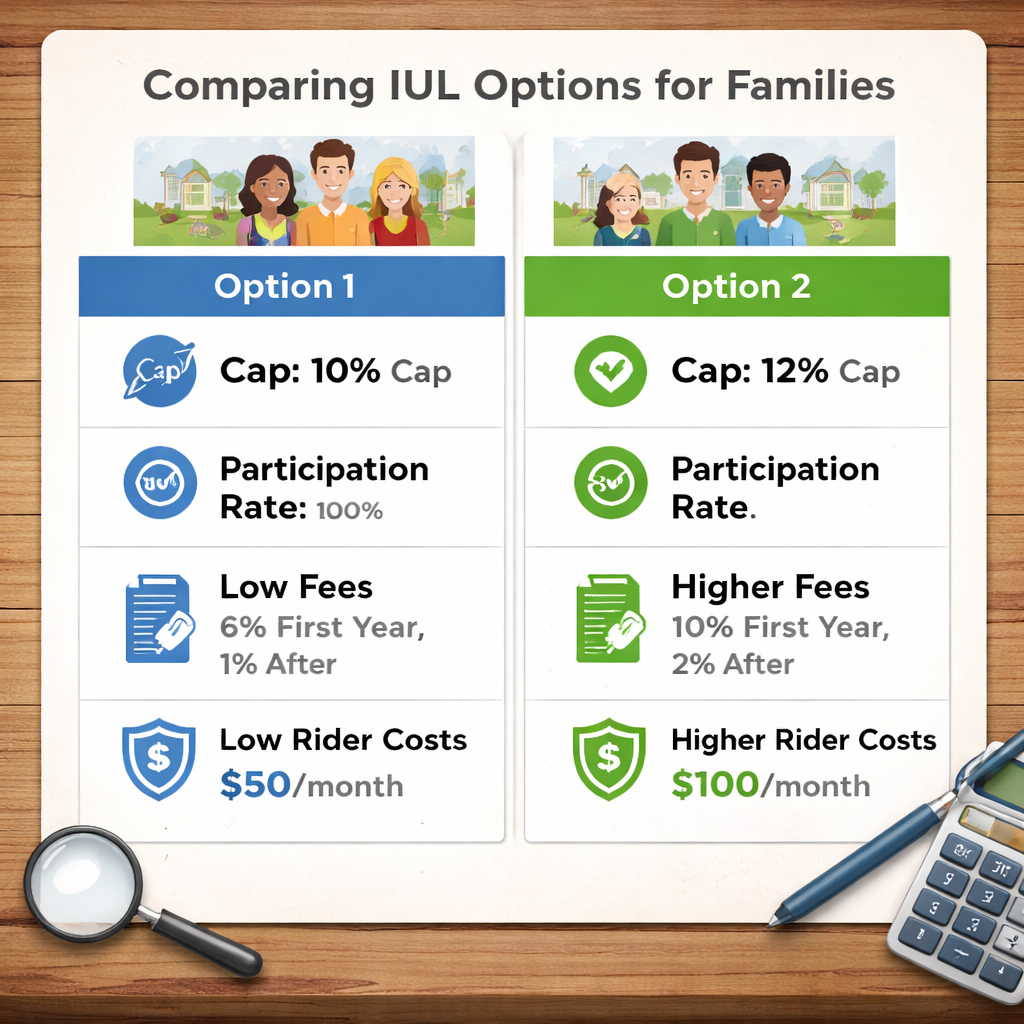
Remember the key finding: only 6 of 29 benefits list a tax advantage. That means you must verify that the carrier you pick actually gives you tax‑deferred growth or tax‑free loans. Look for wording like “growth is tax‑deferred” or “loans are tax‑free under IRS Section 7702”.
Finally, ask about the policy’s “no‑lapse” guarantees. Some carriers, like Lincoln Financial, offer guarantees that keep the policy alive even if cash value dips. Those can be useful if you expect income swings.
Step 5: Implement Your IUL Strategy and Review Regularly
You’ve picked a carrier and riders. Now you need to fund the policy and keep it healthy.
First year: set up automatic premium payments. Put the amount you can afford, even if it’s a little above the minimum COI. Over‑funding early builds cash value faster and can lock in lower COI later.
Second year: schedule a policy review. Look at the cash‑value growth, the COI charges, and the crediting rate for the index. If the cap has dropped, you might want to shift some cash to a fixed‑interest account if your policy allows.
Third year onward: run a Monte Carlo simulation if you have a large policy. Capital for Life suggests using such models to see how the policy might perform under different market scenarios. It helps you decide if you need to add more premium, change allocations, or adjust riders.
Annual checklist:
- Confirm the cash value still covers the COI. If not, increase premium or reduce rider costs.
- Check the loan‑to‑value ratio. Keep it under 80% to avoid tax issues.
- Review any rider triggers. Make sure you still need them.
- Ask your agent about any upcoming cap changes.
- Consider a stress test: what happens if the index is flat for three years?
Real example: Mark, a small‑business owner, used a premium‑financing strategy to fund a $1 million IUL. Each year he borrowed from a bank at a low rate and used the loan to pay the premium. He kept an eye on the COI and adjusted the loan amount when the policy’s cash value grew. After 15 years he had $250,000 cash value he could tap for a business expansion, all while keeping the death benefit for his family.
If you prefer a simpler route, just keep the policy on autopilot. Many families let the cash value grow, then take tax‑free loans in retirement to supplement Social Security. The key is to keep the policy in force , a lapse wipes out the death benefit and can trigger taxes.
For detailed guidance on optimisation, seeCapital for Life’s optimisation guide. It covers Monte Carlo, stress testing, and premium‑financing.
In short, treat your IUL like a living tool, not a set‑and‑forget product. Review, adjust, and use the cash value wisely to keep both protection and growth on track.
FAQ
What are indexed universal life benefits for families?
Indexed universal life benefits for families combine a lifelong death benefit with a cash‑value account that grows based on a market index. The cash value is tax‑deferred and can be accessed through loans or withdrawals, which many families use for college costs, mortgage payments, or retirement income. Living‑benefit riders can also give tax‑free money if a serious illness occurs.
How does the cash value grow in an IUL?
The cash value is linked to an index like the S&P 500. Each crediting period the insurer applies a cap and a floor. If the index goes up, you earn up to the cap (often 8‑12%). If it goes down, the floor (usually 0%) protects you from loss. The growth is tax‑deferred, meaning you don’t pay income tax each year.
Can I use the cash value for retirement income?
Yes. You can take policy loans or withdrawals up to your basis without paying tax, as long as the policy stays in force. Many families use these tax‑free loans to supplement Social Security or to cover unexpected expenses in retirement.
What living‑benefit riders should I consider?
Common riders include accelerated death‑benefit for critical or chronic illness, long‑term‑care coverage, and over‑loan protection. Each adds a modest premium cost. Choose a rider that matches your biggest risk , health issues for younger families, or long‑term‑care for older adults.
How often should I review my IUL policy?
At least once a year. Look at cash‑value growth, COI charges, cap rates, and any rider costs. If the cash value isn’t covering the COI, you may need to increase premium or adjust allocations. Annual reviews keep the policy aligned with your goals.
Is the death benefit from an IUL tax‑free?
Generally, yes. The death benefit is paid to beneficiaries income‑tax free in the United States. Some jurisdictions may have estate‑tax rules, so check local laws or talk to a tax professional.
What happens if I miss a premium payment?
If the cash value is enough to cover the cost of insurance, the policy stays in force even if you skip a payment. If cash value drops too low, the policy could lapse, ending both the death benefit and any cash value you have built.
Can I change the death benefit amount later?
Yes. Most IULs let you increase or decrease the death benefit, subject to underwriting and possible fee changes. Raising the benefit may require a medical exam, while lowering it can reduce future premium costs.
Conclusion
Indexed universal life benefits for families give you a safety net and a way to grow cash inside a life‑insurance wrapper. You get a tax‑free death benefit, tax‑deferred cash growth, flexible premiums, and optional living‑benefit riders. By following the five steps , assessing needs, learning how the policy works, picking the right living benefits, comparing carriers and riders, and reviewing the plan each year , you can build a solid financial foundation for your loved ones.
Remember to check caps, participation rates, and fees. Use the quick‑verdict insight to focus on the “Tax‑advantaged cash value growth” benefit. And always work with a licensed advisor who can run personalized illustrations.
If you’re ready to protect your family and start growing cash for the future,schedule a free consultationwith Life Care Benefit Services today. We’ll help you pick the right indexed universal life policy, add the right riders, and set up a review schedule that keeps your plan on track for years to come.