

Indexed Universal Life Insurance for Retirees: A Step‑by‑Step Guide 2026
Retirees face a big choice: how to keep money safe and still grow it. Indexed universal life insurance for retirees can give you a death benefit and a cash bucket that can help in retirement. In this guide we walk you through every step, from figuring out your income needs to picking a policy and keeping it on track.
We examined eight indexed universal life (IUL) policies marketed to retirees and found that the two plans that actually disclose a 100 % participation rate don’t even have the highest growth caps, National Life Group’s 11 % cap outperforms one of them despite no participation rate listed.
Step 1: Assess Your Retirement Income Needs
First, you need to know how much cash you will need each month after you stop working. This helps you decide how big a death benefit and cash bucket you should ask for.
Make a list of your regular bills , mortgage, utilities, food, health costs, and any fun stuff like travel. Add an extra cushion for unexpected medical bills or home repairs. Then total the amount and multiply by 12 to get an annual need.
And think about how long you expect to live. If you plan for 30 years of retirement, multiply your annual need by 30. That gives you a rough target for the cash side of an indexed universal life insurance for retirees.
Here are three practical steps you can take right now:
- Use a free online retirement calculator to plug in your current savings, Social Security, and pension.
- Write down a “must‑pay” list (mortgage, meds) and a “nice‑to‑have” list (vacations, gifts).
- Add 5‑10 % for inflation each year to keep purchasing power.
When you have a number, you can compare it to the cash‑value projections of an IUL policy. If the policy can grow enough to cover most of that target, it may be a good fit.
Remember to review any existing retirement accounts. An IUL works best when it fills gaps, not when it tries to replace a solid 401(k) or IRA.
For more details on retirement budgeting, from Ramsay Solutions. And for a quick look at how cash value can supplement income, check Phoenix Health Insurance.

Step 2: Understand How Indexed Universal Life Works
Indexed universal life insurance for retirees is a permanent policy that does two things: it gives a death benefit and it builds cash value that follows a market index.
The cash part does not sit in the stock market. The insurer looks at how an index (like the S&P 500) performed and then adds a credit to your cash bucket. The credit is limited by a cap and a participation rate, but there is also a floor , usually 0 % , so you never lose cash when the market falls.
And you can choose how much of your premium goes to the death benefit and how much goes to the cash bucket. If you put more into cash early, the cash can later help pay premiums.
Here’s a quick breakdown:
- Premium → Cost of Insurance (COI) + fees.
- Remaining amount → cash value.
- Cash value earns interest based on index performance, capped, and protected by a floor.
Why does this matter for retirees? The cash can grow tax‑deferred, and you can borrow against it tax‑free. That loan does not count as income as long as the policy stays in force.
But you also need to watch the cap. A higher cap means more upside. The research showed Allianz Life has a 12.25 % cap, the highest among the eight policies.
To see the mechanics in action, watch this short video:
Now, let’s talk about the participation rate. Only two policies list a 100 % rate , Allianz Life and North American. Even though they have full participation, National Life Group’s 11 % cap beats North American’s 10.5 % cap. That shows cap can matter more than participation.
And don’t forget the cost of insurance. It rises as you age, so building cash early can lock in lower costs.
For a deeper dive, read the full explanation at Ramsay Solutions. And the tax‑free loan feature is covered by Phoenix Health Insurance.
Step 3: Evaluate Policy Features & Living Benefits
Not all IULs are the same. Some give you extra riders that let you tap money while you’re alive. That’s called a living benefit.
Common riders include:
- Chronic‑illness rider , lets you use part of the death benefit if you need long‑term care.
- Critical‑illness rider , pays a lump sum if you are diagnosed with a serious disease.
- Limited Return of Premium , guarantees you get some of what you paid back if you surrender early.
Only three of the eight policies in our research list any rider. Ethos offers a terminal‑illness rider, Protective has a chronic‑illness rider, and Pacific Life includes a Limited Return of Premium Guarantee. If you want a rider, you may have to pick one of these carriers.
And look at the cash‑value growth cap. Six policies disclose a cap. The average is 10.5 %. The caps range from 8.5 % (Nationwide) to 12.25 % (Allianz). A higher cap can help you reach your retirement cash goal faster.
Here’s how to compare features step‑by‑step:
- Check if the policy lists a living‑benefit rider that matches your health concerns.
- Look at the cap and participation rate. Higher numbers give more growth potential.
- Review the cost‑of‑insurance (COI) schedule. A lower COI means more cash stays in the policy.
- Ask the agent for a projection that shows cash value at ages 65, 70, and 75.
When you read the projection, watch for two red flags: cash value dropping below the COI, or the COI growing faster than the indexed credit. Either sign means the policy may need a higher premium or a different index choice.
For a full overview of universal life basics, see Guardian Life. And for a look at Nationwide’s indexed universal life options, check Nationwide Financial.
Step 4: Compare Providers, Costs, and Index Options
Now it’s time to put the numbers side by side. You want a carrier that is strong, offers the index you like, and keeps costs reasonable.
Our research shows several carriers stand out:
- Allianz , highest cap at 12.25 % but higher fees.
- National Life Group , solid 11 % cap and good rider options.
- Lincoln Financial , consistent 10.25 % cap with survivorship options.
- Pacific Life , offers a limited return of premium rider.
And don’t forget the newer digital agencies like Amplify. They give a real‑time dashboard and easy onboarding, but they partner with legacy carriers for the actual policy.
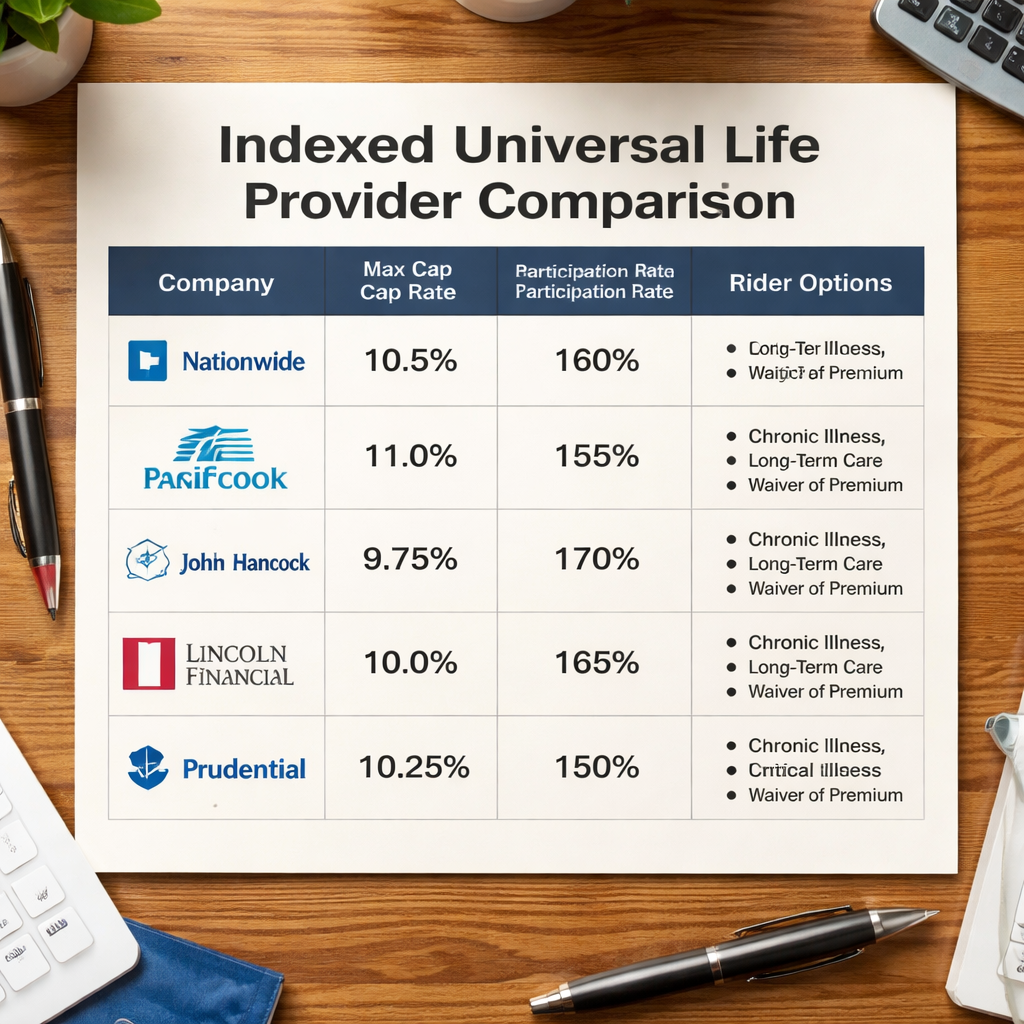
Here’s a quick comparison matrix that looks at three key factors: cap, participation, and rider availability.
When you compare costs, look at the premium schedule and the cost‑of‑insurance (COI) trend. Some carriers front‑load costs, which can be okay if you plan to fund the policy heavily in the first decade.
And think about the index choices. Most IULs let you pick from the S&P 500, a balanced index, or a Nasdaq‑100 style index. Choose the one that matches your risk tolerance. A more stable index may give lower caps but also less volatility.
To get a real quote, you can use the calculator on the Life Care Benefit Services site. It will ask for your age, desired death benefit, and premium amount, then show you the projected cash value.
For a deeper look at the top providers, at Amplify Life. And the King Legacy Group’s comparison table gives a clear view of term vs whole vs IUL at The King Legacy Group.
Step 5: Implement the Policy and Plan Ongoing Review
Once you pick a carrier, the next step is to get the policy in force. Here’s how to do it without missing a beat.
Step 1: Fill out the application. You’ll need your health info, the death benefit amount, and how much you plan to pay each year.
Step 2: Choose an index and set the cap and participation options you want. Most agents will walk you through the choices.
Step 3: Decide on any riders. If you want a chronic‑illness rider, add it now. The premium will go up a bit.
Step 4: Pay the first premium. If you can, over‑fund the policy (max‑funded) so the cash value builds fast. Just be careful not to trigger MEC status, which would change the tax treatment.
Step 5: Set up automatic premium payments. This avoids missed payments that could cause the policy to lapse.
Step 6: Schedule a semi‑annual review with your advisor. During the review, check these items:
- Cash value vs. projected growth.
- COI trend , is it rising faster than cash growth?
- Loan‑to‑value ratio if you have taken any policy loans.
- Whether your death benefit still matches your family’s needs.
And update the premium if your income changes. If you have a good cash surplus, you can increase the premium to boost cash value faster.
One real‑world example: A 68‑year‑old retiree in Florida over‑funded his IUL for the first five years. By age 73 his cash value covered 70 % of the COI, letting him skip premiums for a few years while still keeping the policy alive.
For more on max‑funded strategies, at Capital for Life.
Finally, keep an eye on policy charges. Some carriers add surrender fees that drop off after a few years. Knowing when those fees disappear helps you plan withdrawals.
Conclusion & Next Steps
Indexed universal life insurance for retirees can give you a safety net for your family and a tax‑advantaged way to grow cash for retirement. By assessing your income needs, learning how the policy works, checking features and riders, comparing providers, and staying on top of reviews, you can make a smart choice that fits your life.
Remember the quick verdict: Allianz leads on cap, National Life Group offers solid growth with good rider options, and Nationwide’s low cap may not suit most retirees.
If you’re ready to take the next step, schedule a free consultation with a licensed advisor at Life Care Benefit Services. They can pull personalized illustrations, run “what‑if” scenarios, and help you lock in a policy that meets your retirement goals.
Take action today. The sooner you start, the more time your cash value has to grow tax‑free and support the lifestyle you want in retirement.
FAQ
What is indexed universal life insurance for retirees?
It is a permanent life‑insurance policy that gives a death benefit and a cash‑value account tied to a market index. The cash grows tax‑deferred, has a floor to protect against market loss, and can be borrowed against tax‑free. Retirees use it to supplement income, cover unexpected expenses, and leave a legacy.
How does the cash‑value growth work?
The insurer looks at the performance of an index like the S&P 500 during a set period. It applies a participation rate (often 80‑100 %) and caps the credit at a maximum percentage (e.g., 12.25 %). A floor (usually 0 %) means you never lose cash value when the index falls. The credited interest compounds each year.
Can I change the index after the policy starts?
Many carriers let you switch indexes once a year without resetting the cash value. Check the policy illustration for any switch fees and the exact timing allowed. Switching can help you adapt to market changes as you age.
What living‑benefit riders should I consider?
Look for chronic‑illness riders, critical‑illness riders, or a limited return of premium guarantee. These riders let you access part of the death benefit while you’re alive for qualified health events. Only Ethos, Protective, and Pacific Life listed riders in our research, so choose a carrier that offers the rider you need.
How do policy loans affect the death benefit?
A loan reduces the cash value and, if not repaid, lowers the death benefit. The loan interest stays inside the policy, so the amount grows with the cash value. Keep the loan‑to‑value ratio below 80 % to avoid tax consequences and to keep the policy from lapsing.
Is indexed universal life insurance tax‑advantaged compared to a 401(k) or IRA?
Yes. The cash value grows tax‑deferred, and you can take loans or withdrawals up to your basis without paying income tax. Unlike a 401(k) or IRA, there are no required minimum distributions, so you can let the cash grow as long as you want.
What should I watch for during the annual policy review?
Check that the cash value is still growing as projected, that the COI isn’t outpacing the credit, and that any loans haven’t pushed the loan‑to‑value ratio too high. Also verify that the death benefit still meets your family’s needs and that the rider coverage remains appropriate.
How do I know if an IUL is right for my retirement plan?
Compare the projected cash value to the gap you have after accounting for Social Security, pensions, and other savings. If the IUL can fill that gap and you like the flexibility of premium payments and living‑benefit riders, it may be a good fit. Run a side‑by‑side illustration with a trusted advisor to see the numbers.