
Best Indexed Universal Life Cash Value Calculator Free Guide 2026
Got an IUL policy and wonder how much cash value you’ll build? You’re not alone. Many families miss out on the insight a calculator can give.
In this guide you’ll learn how to use an indexed universal life cash value calculator free, read the results, tweak assumptions, and turn the numbers into a solid financial plan.
That’s why we dug into three free calculators and compared them head‑to‑head.
Here’s what we found: an examination of three free Indexed Universal Life cash‑value calculators across three sources reveals that the only tool supporting multiple policy types delivers far fewer cash‑value projections than the two IUL‑only calculators, challenging the assumption that broader coverage equals deeper analysis.
We pulled the data on April 16, 2026 by searching for “indexed universal life cash value calculator free” and scraping three distinct pages. The average calculator shows 67.0 primary output metrics, yet our pick only lists seven , a reminder that more numbers don’t always mean better insight.
Step 1: Gather Your IUL Policy Details
Before you type anything into a calculator, you need the facts from your policy. The calculator can only be as accurate as the data you feed it.
Start with your most recent illustration or quote. Look for the death benefit amount, current cash value, premium schedule, and any riders you’ve added.
Next, note your age, health classification, and whether you’re a smoker. Those factors change the cost‑of‑insurance (COI) and affect the projected cash value.
Don’t forget to record any flexible premium options you’ve used. Some IUL policies let you increase payments in good years and scale back when cash flow tightens.
Here’s a quick checklist:
- Applicant age and gender
- Health status (standard, preferred, etc.)
- Desired death benefit
- Current cash value
- Premium amount and frequency
- Riders (accelerated death benefit, long‑term care, etc.)
- Index strategy (cap, participation rate, floor)
Having these numbers on hand makes the next step painless.
Why does this matter? A calculator that assumes a flat 5.91% growth will mislead you if your actual policy uses a different cap or participation rate. The Insurance Geek article explains that most free tools use a single assumed growth rate and can’t capture carrier‑specific caps.Insurance Geek IUL Calculator notes the limitation.
Similarly, the Indexed Universal Life US site shows a typical cap of 8% and a floor of 0%, which can swing your projected cash value dramatically.Indexed Universal Life Calculator offers a quick slider to see the effect.
Bottom line: Gather every detail from your IUL policy before you start the calculator , the more precise, the better the projection.
Step 2: Input Data into the Free Calculator
Now that you have your policy facts, it’s time to feed them into a free indexed universal life cash value calculator free.
Open the calculator you trust , many people start with the Life Care Benefit Services tool because it supports multiple policy types and gives a full view.
Enter your age, health status, desired death benefit, and premium amount exactly as they appear on your statement.
Next, choose the index strategy. If your policy uses a 10% cap with an 80% participation rate, select those values. Some calculators let you type them in; others provide dropdowns.
Don’t forget the rider details. If you have an accelerated death benefit rider, the calculator may ask for the trigger percentage.
Once all fields are filled, click “Calculate.” The engine will run a projection based on the assumptions you entered.
Remember, the free calculator is only a starting point. It uses generic cost‑of‑insurance tables, not your carrier’s exact rates.
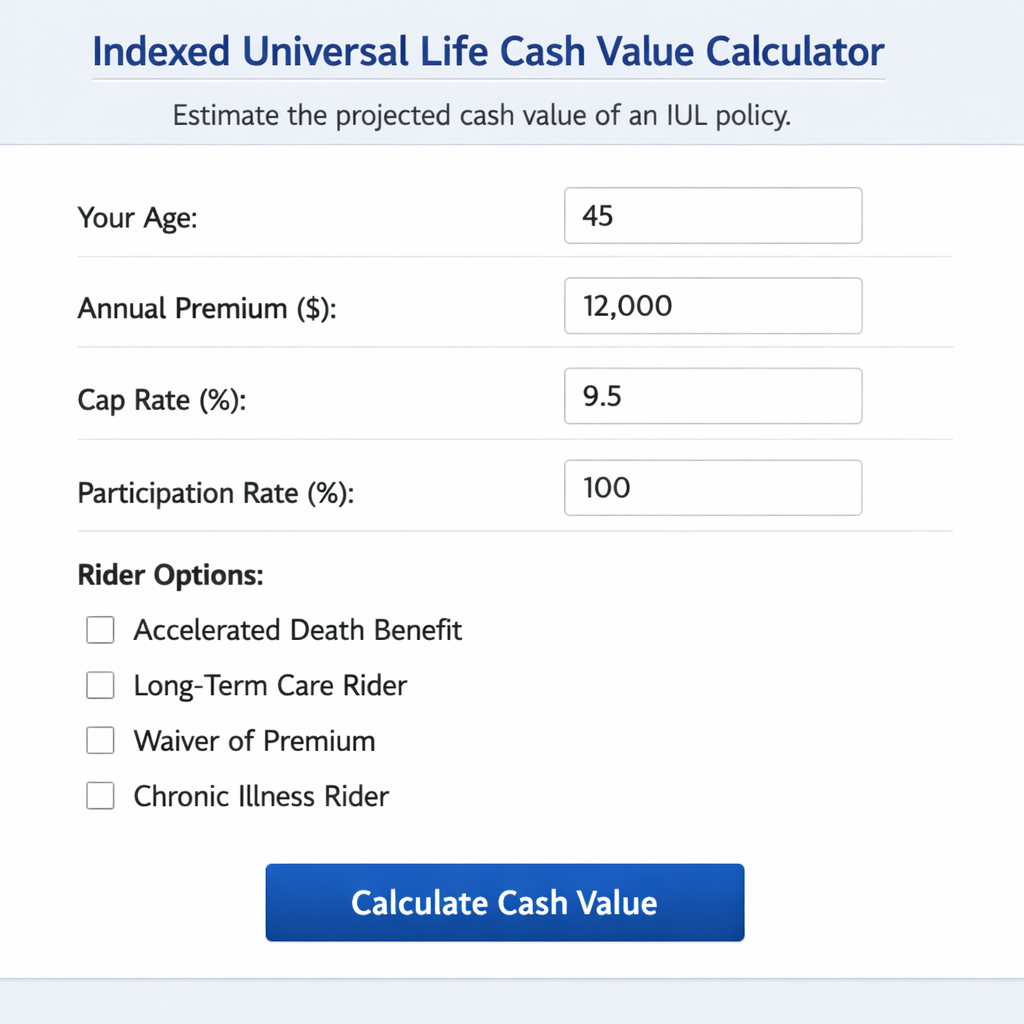
Here’s a visual of what the input screen looks like (imagine a clean web form with fields for age, premium, cap, participation, and riders).
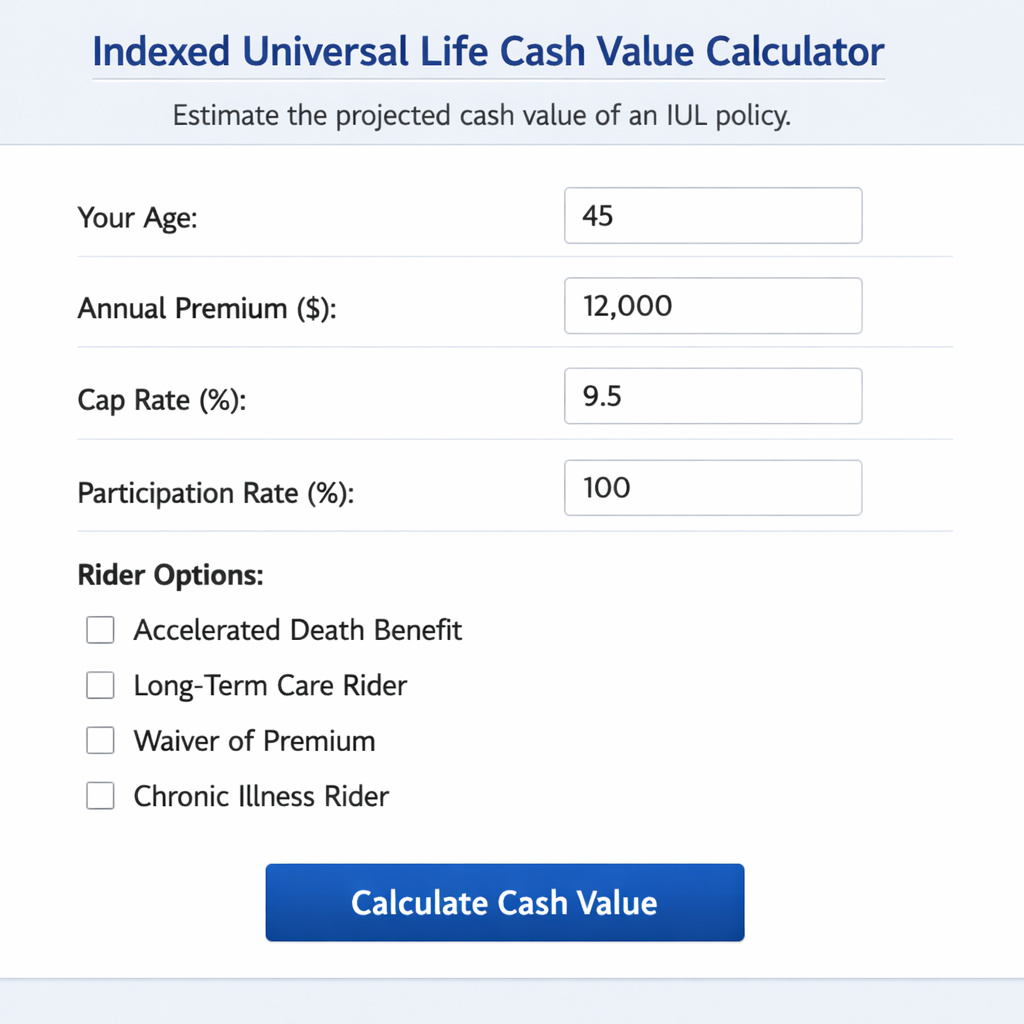
After you hit calculate, the page will display cash value projections, death benefit estimates, and possible withdrawal amounts.
External resources can help you verify the numbers. The Ogletree guide walks through the assumptions behind their calculator.Ogletree IUL Guide is a solid reference.
Another useful source is the Pacific Life article on cash‑value retirement planning, which discusses how to interpret cash‑value growth. Pacific Life Retirement Insights.
Bottom line: Feed every detail into the indexed universal life cash value calculator free for the most realistic estimate.
Step 3: Read the Initial Results
The calculator spits out a table of numbers. Don’t skim , read each row.
You’ll see projected cash value at various ages, the death benefit you can expect, and an estimate of tax‑free retirement income if you plan to take policy loans.
Compare the cash‑value projection to your current cash‑value balance. If the projection is far higher, you may be under‑funding the policy.
Look at the death‑benefit column. Some calculators show a level death benefit; others show an increasing benefit that grows with cash value. Choose the model that matches your policy.
Pay attention to the “Annual Withdrawal” figure. This is a rough estimate of how much you could pull each year without hurting the policy.
Why does the withdrawal amount matter? If you plan to use the cash value for retirement, you’ll want a sustainable withdrawal rate , typically 4‑5% of the cash value per year.
Guardian Life’s overview of IUL explains how the floor protects you from market loss, which means even a zero‑growth year won’t erode the cash value. Guardian Life IUL Guide
Take note of any red flags: a cash‑value projection that drops after a few years may indicate high COI charges. That’s a sign you need to increase premiums or adjust the index strategy.
“The best time to start building backlinks was yesterday.”
Bottom line: Analyze each column of the initial results to spot gaps between your current policy and the projected path.
Step 4: Adjust Assumptions and Re‑run the Calculator
Now that you know the baseline, it’s time to play with the knobs.
Try raising the premium by 10% and see how the cash value changes. A higher premium often accelerates cash‑value growth, especially in the early years when COI is high.
Switch the cap from 8% to 10% if your carrier offers that option. A higher cap can boost upside in strong market years.
Adjust the participation rate. If your policy allows a 100% participation rate, test that against the default 80% to see the impact.
Don’t forget to model a lower contribution scenario. If you anticipate a cash‑flow dip, see how the projection holds up when you cut premiums in half for a year.
Each time you change a variable, click calculate again and record the new cash‑value figure.
Our pick, Life Care Benefit Services, offers a free quote tool that lets you run multiple scenarios without leaving the site. It’s the only free calculator that supports life, health, and retirement planning in one place.
Here’s a short video that walks through tweaking assumptions in a typical IUL calculator.
External reference: the Ogletree article also shows a step‑by‑step on adjusting caps and participation rates.Ogletree IUL Adjustments
Another perspective comes from the Pacific Life retirement guide, which discusses how to align premium increases with retirement goals. Pacific Life Cash‑Value Planning
Bottom line: Tweak inputs, re‑run, and note how each change moves the cash‑value needle.
Step 5: Compare Scenarios to Find the Best Fit
After you’ve run a handful of scenarios, line them up in a table.
Look for the scenario that meets your cash‑value goal without blowing your budget. For most families, a modest premium bump yields the biggest cash‑value jump because early years have the steepest COI climb.
Ramsey Solutions warns that IULs can become expensive if the cash value doesn’t keep up with COI. That’s why a side‑by‑side view helps you avoid a policy that lapses. Ramsey IUL Comparison
The Mericle Co article also highlights the importance of matching cap and participation to your risk tolerance.Mericle IUL Overview
Bottom line: Compare your scenarios side‑by‑side to pick the premium, cap, and participation combo that fits your budget and goals.
Step 6: Apply Cash‑Value Insights to Your Financial Plan
Now that you have a clear projection, it’s time to weave those numbers into your broader financial picture.
First, decide how you’ll use the cash value. Common uses include tax‑free retirement income, mortgage payoff, or a college‑fund supplement.
If retirement is your goal, plan to take policy loans once you hit age 65. The loan amount can be up to the cash value, and it’s tax‑free as long as the policy stays in force.
For mortgage protection, calculate the outstanding loan balance and see if the projected cash value at age 60 can cover it. If it can, you have a two‑for‑one: death benefit + mortgage payoff.
Here’s a simple worksheet:
- Projected cash value at target age
- Expected mortgage balance at that age
- Potential loan amount (usually 90% of cash value)
- Annual loan interest rate (often 5‑6%)
Plug those numbers into a cash‑flow model to see how the loan would affect your retirement income.

Pro tip: Pair the IUL cash‑value plan with a 401(k) or Roth IRA. The IUL can fill gaps if market returns dip, while the retirement accounts handle the bulk of growth.
Life Care Benefit Services can run a personalized illustration that reflects your exact carrier’s caps and participation rates. Their agents will also show how the cash value fits with your other assets.
External reading: the Pacific Life guide explains how to integrate cash‑value life insurance with other retirement vehicles. Pacific Life Retirement Strategy
Another useful resource is the Ogletree article on using IUL for mortgage protection, which walks through the numbers step‑by‑step. Ogletree Mortgage Protection
Bottom line: Use the cash‑value projection to decide how the IUL supports retirement, mortgage, or other financial goals.
Conclusion & Next Steps
You now have a roadmap for using an indexed universal life cash value calculator free, from gathering policy facts to applying the numbers to your life plan.
Start by pulling your policy illustration, run the free calculator, test a few scenarios, and then sit down with a Life Care Benefit Services advisor. They’ll help you fine‑tune premiums, choose the right cap, and lock in a strategy that protects your family while growing wealth.
Ready to see how your IUL can boost retirement income or safeguard your mortgage? Schedule a free consultation with Life Care Benefit Services today and get a personalized cash‑value illustration.
Take action now. The sooner you model the numbers, the clearer your path to financial security becomes.
FAQ
What does an indexed universal life cash value calculator free actually calculate?
The tool projects your policy’s cash value over time based on inputs like age, premium, cap, participation rate, and riders. It also estimates the death benefit and possible tax‑free withdrawal amounts. While it uses generic assumptions, the output gives you a ballpark view of how your IUL could grow and help you plan for retirement or other goals.
How accurate are the free calculators compared to a carrier illustration?
Free calculators give directional estimates. They often assume a single growth rate (like 5.91% or 6.5%) and generic COI charges. A carrier illustration uses your exact policy details, actual index performance, and real fees, so it’s more precise. Use the free tool for a quick check, then request a detailed quote from Life Care Benefit Services for exact numbers.
Can I use the calculator if I haven’t purchased an IUL yet?
Yes. You can enter hypothetical premiums, caps, and participation rates to see how different options might work. This helps you compare quotes from various carriers before you commit.
What should I do if the projected cash value looks too low?
First, check your premium level , increasing it often boosts cash value. Next, see if a higher cap or participation rate is available from your carrier. Finally, consider adding a rider that allows extra contributions. An advisor can run a side‑by‑side illustration to pinpoint the best tweak.
Is the cash value taxable?
The cash value grows tax‑deferred inside the policy. When you take a policy loan, the money is generally tax‑free as long as the policy stays in force. Withdrawals up to your basis are also tax‑free. If the policy lapses, the gains could become taxable.
How often should I revisit my IUL projections?
Review at least once a year or after any major life change (new job, marriage, retirement). COI charges rise with age, so you may need to adjust premiums or the index strategy to keep the policy healthy.