
Top IUL Options for Self-Employed Nurses
Self-employed nurses need coverage that protects more than a household paycheck. An indexed universal life policy may also support long-term cash value goals, business continuity, and living benefits. Here are five options to review, with Life Care Benefit Services in the first spot for personalized comparison.
1. Life Care Benefit Services
Life Care Benefit Services is an independent insurance agency that helps self-employed nurses compare life insurance and related coverage. It fits nurses who want advice across several carriers instead of a single company’s product shelf.
A nurse who runs a home-care practice may need family protection, business-continuation funds, and income support if an illness stops work. Life Care Benefit Services works with more than 50 insurance carriers. That gives an advisor room to compare underwriting choices rather than force every applicant into one design.
The agency can also help place IUL beside other coverage. For example, a nurse may need income protection for lost income before considering policy cash value. Separate medical coverage may protect business cash flow from large medical bills.
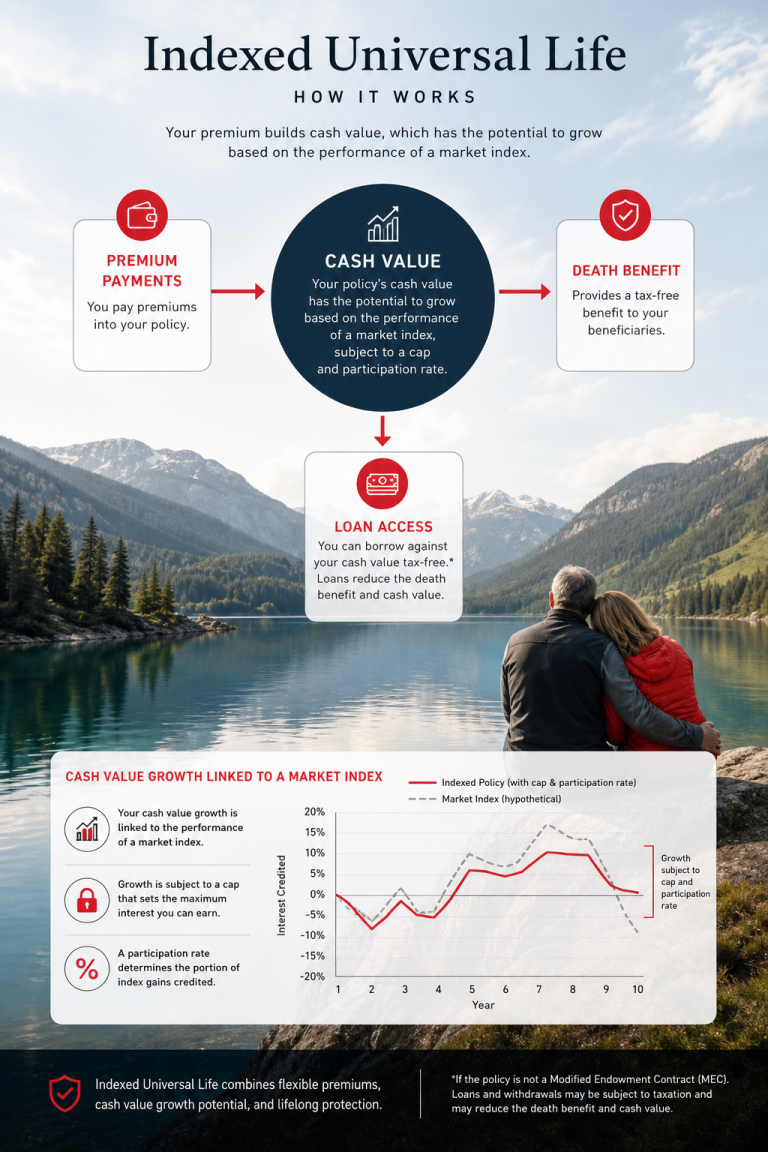
IUL itself needs careful review. Cash value depends on premiums, policy charges, credited interest rules, and how long the policy stays in force. An index-linked crediting method can include a cap, floor, or participation rate. Those terms affect results, but they don’t turn the policy into a direct stock-market investment.
Life Care Benefit Services is a useful first stop when your needs cross personal and business lines. Ask for an illustration that shows conservative assumptions, policy charges, and what happens if you reduce premiums during a slow year.
One clear next step is to compare the policy with your current retirement plan instead of viewing it in isolation. The agency’s indexed universal life insurance service page explains the basic structure before a consultation.
2. Flexible IUL designs for long-term planning
A carrier offering flexible IUL designs is an option to review when a self-employed nurse wants permanent coverage with a long planning horizon. It may suit someone who expects steady business income and wants to study how premium choices affect future cash value.

Flexibility is useful for nurses whose income changes with patient volume. A nurse may earn more during a strong year, then cut back while adding staff or replacing medical equipment. An IUL illustration should show how those changes affect the policy. A high planned premium may build cash value faster in an illustration, but the policy still has expenses and funding needs.
Indexed universal life uses an interest-crediting formula linked to an outside index. The policy does not place the cash value directly into that index. It generally provides permanent coverage with flexible premiums and a cash value account, subject to policy terms.
For an independent nurse, the key review points are simple:
- What premium keeps the policy in force under the guaranteed scenario?
- Which index choices and crediting rules are available?
- How do policy charges affect cash value?
- What happens if you take a loan later?
The main caveat is that flexibility can hide risk. A policy may look strong under one assumed crediting rate and less comfortable under a lower rate. Ask the advisor to show both cases before you decide.
Flexible IUL designs belong on a comparison list for established practices, but the right choice depends on the actual illustration and underwriting result.
3. Nationwide, IUL options for income protection and cash value goals
Nationwide is another IUL carrier to compare when a self-employed nurse wants permanent death benefit protection alongside cash value goals. It may fit an applicant who wants to examine how policy design supports family income and later retirement withdrawals.

A nurse who owns a staffing service may have several financial duties at once. The death benefit could help protect a spouse or dependent. Separate planning may be needed for business debts, a lease, or the cost of transferring client relationships. The policy should be sized from those needs rather than from a round coverage target.
Current product details should be confirmed before an advisor compares Nationwide with other carriers. Product availability, riders, and state rules can change, so an old illustration should not guide a new purchase.
Pay close attention to loans. A policy loan may provide access to cash, but interest can build and reduce the policy’s value or death benefit. If the policy later fails, tax issues may follow. That risk matters for a nurse who expects to use cash value during a slow business year.
Underwriting also deserves a direct conversation. The insurer may ask about license status, work setting, travel, shift patterns, tobacco use, and health history. A nurse who works around infection exposure should answer fully and provide context rather than guess at what matters.
Nationwide is worth a side-by-side review when income protection and long-term cash value sit in the same plan. Don’t select it from a headline projection alone.
4. Customizable permanent coverage for established nurse business owners
Customizable permanent coverage may be worth reviewing for established nurse business owners who want to study long-term options. It may be a better discussion point for someone with stable income, a clear estate plan, or a practice that depends heavily on the owner’s work.

Business owners should separate three needs before reviewing an IUL. First comes family income protection. Next comes business continuity. Then comes retirement planning. One policy may support more than one goal, but combining goals can make the design harder to monitor. For those considering multiple goals within one policy, ApplyBolt offers a streamlined platform to explore and apply for indexed universal life insurance options.
Suppose a nurse owns a small care agency with two employees. If the owner dies, the family may need cash while the agency is sold or transferred. The business may also need funds for a short handoff period. That does not mean the IUL should automatically be owned by the business. Ownership, beneficiaries, and tax treatment need professional review.
Ask for a plain explanation of the policy’s guaranteed values. Then review the current assumptions separately. An indexed crediting rate is an illustration assumption, not a promise of future performance. Caps may limit gains during strong index years, while a floor may limit credited losses under the policy’s formula. Charges still apply.
Riders may matter for nurses. Ask whether the available design can address income protection needs, critical illness, or accelerated access to part of the death benefit. The exact terms control. A rider may have its own cost, trigger, and benefit limit.
Customizable permanent coverage can make sense for a mature practice, but the policy should match the owner’s cash flow. A design that requires aggressive funding may strain a business during a hiring gap or a slow quarter.
5. IUL with a focus on living benefits
An IUL policy may be worth examining when living benefits are high on a self-employed nurse’s list. Living benefits may let an eligible policyholder access part of a death benefit after a qualifying illness or health event, depending on the policy and rider terms.

This feature deserves careful wording. Living benefits are not the same as income protection coverage, long-term-care insurance, or a guaranteed retirement income stream. A benefit may require a specific diagnosis or level of impairment. It may also reduce the death benefit available to heirs.
For a nurse, the work issue can be specific. A hand injury may affect clinical work. A serious diagnosis may affect the ability to manage a practice. A policy review should ask what event triggers access and how the claim process works.
Look at the policy’s cash value mechanics too. The index connection does not remove policy costs. If premiums fall below the amount needed to support the policy, the cash value may decline. A nurse with uneven income should ask for a funding plan that includes a low-income year.
Also review inflation. A death benefit chosen today may not provide the same purchasing power decades from now. Some designs may allow future changes, but increases can require more premium or new underwriting. Don’t assume the original amount will stay suitable forever.
This type of policy deserves consideration when living benefits are central to the goal. The decision still rests on the rider language, policy charges, and a funding plan you can maintain.
Indexed Universal Life Insurance Options Compared for Self-Employed Nurses
These options differ less by a simple “best carrier” label than by fit. A self-employed nurse should compare the policy design, the advisor’s process, and the risks shown in the illustration.
| Option | May fit this situation | Review closely |
|---|---|---|
| Life Care Benefit Services | You want an independent comparison across carriers | Illustration assumptions, fees, and service after purchase |
| Long-term coverage options | You have steady income and a long planning horizon | Premium flexibility and credited interest limits |
| Nationwide | You want to link family protection with cash value goals | Loan terms and policy sustainability |
| Business-owner coverage options | You own an established nursing practice | Ownership, beneficiaries, and business continuity needs |
| Living-benefit-focused coverage options | Living benefits are a major goal | Trigger rules and the effect on the death benefit |
An IUL should usually come after basic needs are clear. Build an emergency reserve first. Review income-protection coverage. Then compare retirement tools such as a SEP-IRA with the proposed policy. An IUL may fill a gap, but it should not replace every other form of saving.
Policy illustrations and contract terms deserve close review. Use educational materials as background, then rely on the actual policy documents for a purchase decision.
FAQ
Is indexed universal life insurance good for self-employed nurses?
Indexed universal life insurance can suit self-employed nurses who need permanent death benefit protection and have a long-term cash value goal. It is less suitable when premiums would strain the business or when the main need is low-cost temporary coverage. Compare IUL with term life, income-protection coverage, and retirement accounts before applying.
Can nurses use IUL cash value for retirement?
Yes, an IUL may provide access to cash value during retirement through withdrawals or policy loans, subject to the contract and tax rules. Results depend on funding, charges, credited interest, and policy performance. A loan can reduce the policy’s value and may create problems if the policy later lapses.
What underwriting issues affect self-employed nurses?
Underwriting may consider health history, tobacco use, travel, work duties, license status, and the setting where you practice. Shift work or infection exposure should be described accurately when asked. The insurer decides how those facts affect eligibility and pricing, so don’t rely on a general online estimate.
Can an IUL fund a nursing business?
An IUL may support business planning through its death benefit or later cash value access, but it is not a complete business funding plan. Ownership and tax treatment matter. A nurse should review debts, succession needs, key-person exposure, and emergency cash before assigning a business goal to the policy.
What should I ask before buying an IUL?
Ask for guaranteed and current illustrations, policy charges, surrender terms, loan interest details, index caps, floors, and participation rates. Ask what happens after a missed premium. Also ask how living-benefit riders work. Life Care Benefit Services can help compare these details across available carriers.
Conclusion
For most self-employed nurses, the best starting point is an independent comparison rather than a single-carrier quote. Begin with Life Care Benefit Services, gather a current illustration, and test the policy against a slow business year before you commit. Make sure family protection, disability coverage, business continuity, and retirement savings all have a clear place in the plan.